

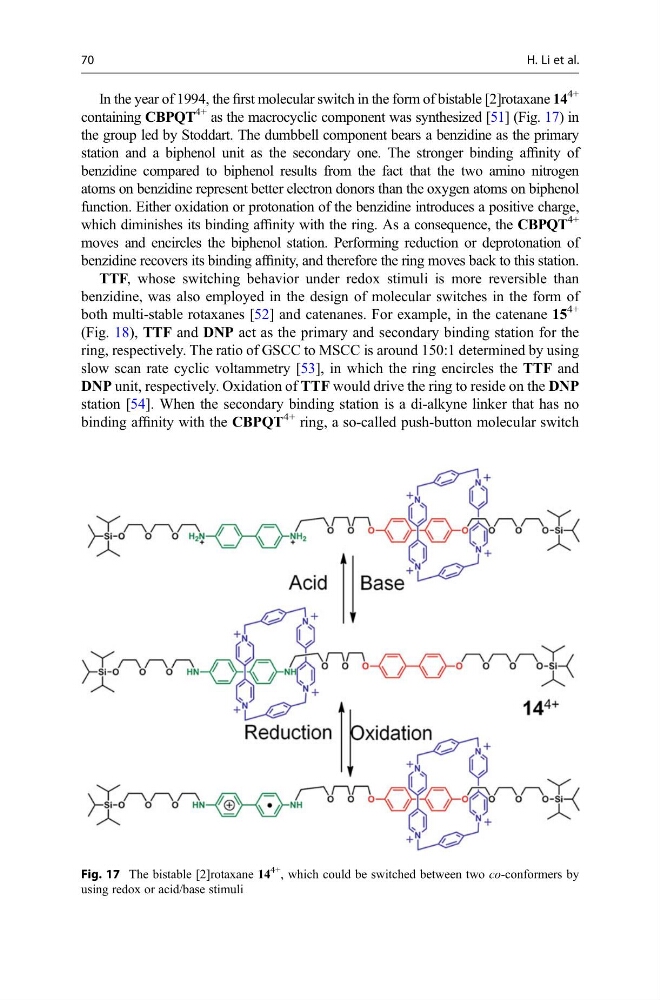
In the year of 1994, the first molecular switch in the form of bistable [2]rotaxane 14
4+
containing CBPQT
4+ as the macrocyclic component was synthesized [51] (Fig. 17) in
the group led by Stoddart. The dumbbell component bears a benzidine as the primary
station and a biphenol unit as the secondary one. The stronger binding affinity of
benzidine compared to biphenol results from the fact that the two amino nitrogen
atoms on benzidine represent better electron donors than the oxygen atoms on biphenol
function. Either oxidation or protonation of the benzidine introduces a positive charge,
which diminishes its binding affinity with the ring. As a consequence, the CBPQT
4+
moves and encircles the biphenol station. Performing reduction or deprotonation of
benzidine recovers its binding affinity, and therefore the ring moves back to this station.
TTF, whose switching behavior under redox stimuli is more reversible than
benzidine, was also employed in the design of molecular switches in the form of
both multi-stable rotaxanes [52] and catenanes. For example, in the catenane 15
4+
(Fig. 18), TTF and DNP act as the primary and secondary binding station for the
ring, respectively. The ratio of GSCC to MSCC is around 150:1 determined by using
slow scan rate cyclic voltammetry [53], in which the ring encircles the TTF and
DNP unit, respectively. Oxidation of TTF would drive the ring to reside on the DNP
station [54]. When the secondary binding station is a di-alkyne linker that has no
binding affinity with the CBPQT
4+ ring, a so-called push-button molecular switch
Fig. 17 The bistable [2]rotaxane 14
4+ , which could be switched between two co-conformers by
using redox or acid/base stimuli
70
H. Li et al.
4+
containing CBPQT
4+ as the macrocyclic component was synthesized [51] (Fig. 17) in
the group led by Stoddart. The dumbbell component bears a benzidine as the primary
station and a biphenol unit as the secondary one. The stronger binding affinity of
benzidine compared to biphenol results from the fact that the two amino nitrogen
atoms on benzidine represent better electron donors than the oxygen atoms on biphenol
function. Either oxidation or protonation of the benzidine introduces a positive charge,
which diminishes its binding affinity with the ring. As a consequence, the CBPQT
4+
moves and encircles the biphenol station. Performing reduction or deprotonation of
benzidine recovers its binding affinity, and therefore the ring moves back to this station.
TTF, whose switching behavior under redox stimuli is more reversible than
benzidine, was also employed in the design of molecular switches in the form of
both multi-stable rotaxanes [52] and catenanes. For example, in the catenane 15
4+
(Fig. 18), TTF and DNP act as the primary and secondary binding station for the
ring, respectively. The ratio of GSCC to MSCC is around 150:1 determined by using
slow scan rate cyclic voltammetry [53], in which the ring encircles the TTF and
DNP unit, respectively. Oxidation of TTF would drive the ring to reside on the DNP
station [54]. When the secondary binding station is a di-alkyne linker that has no
binding affinity with the CBPQT
4+ ring, a so-called push-button molecular switch
Fig. 17 The bistable [2]rotaxane 14
4+ , which could be switched between two co-conformers by
using redox or acid/base stimuli
70
H. Li et al.