

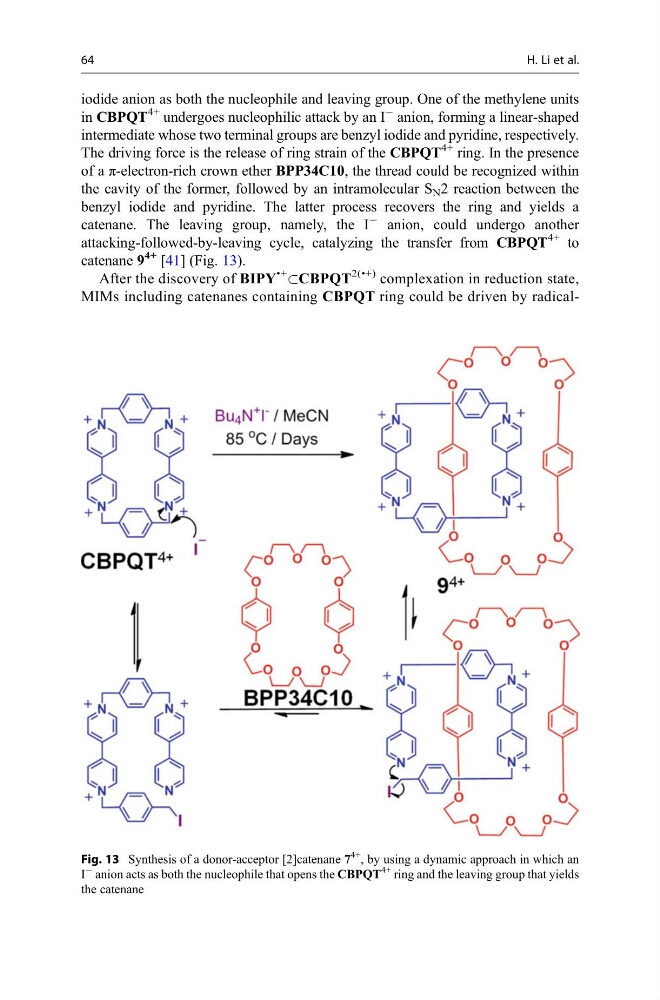
iodide anion as both the nucleophile and leaving group. One of the methylene units
in CBPQT
4+ undergoes nucleophilic attack by an I
À anion, forming a linear-shaped
intermediate whose two terminal groups are benzyl iodide and pyridine, respectively.
The driving force is the release of ring strain of the CBPQT
4+ ring. In the presence
of a π-electron-rich crown ether BPP34C10, the thread could be recognized within
the cavity of the former, followed by an intramolecular S N 2 reaction between the
benzyl iodide and pyridine. The latter process recovers the ring and yields a
catenane. The leaving group, namely, the I
À anion, could undergo another
attacking-followed-by-leaving cycle, catalyzing the transfer from CBPQT
4+ to
catenane 9
4+ [41] (Fig. 13).
After the discovery of BIPY
•+
&CBPQT
2(•+) complexation in reduction state,
MIMs including catenanes containing CBPQT ring could be driven by radicalFig. 13 Synthesis of a donor-acceptor [2]catenane 7
4+ , by using a dynamic approach in which an
I
À anion acts as both the nucleophile that opens the CBPQT
4+ ring and the leaving group that yields
the catenane
64
H. Li et al.
in CBPQT
4+ undergoes nucleophilic attack by an I
À anion, forming a linear-shaped
intermediate whose two terminal groups are benzyl iodide and pyridine, respectively.
The driving force is the release of ring strain of the CBPQT
4+ ring. In the presence
of a π-electron-rich crown ether BPP34C10, the thread could be recognized within
the cavity of the former, followed by an intramolecular S N 2 reaction between the
benzyl iodide and pyridine. The latter process recovers the ring and yields a
catenane. The leaving group, namely, the I
À anion, could undergo another
attacking-followed-by-leaving cycle, catalyzing the transfer from CBPQT
4+ to
catenane 9
4+ [41] (Fig. 13).
After the discovery of BIPY
•+
&CBPQT
2(•+) complexation in reduction state,
MIMs including catenanes containing CBPQT ring could be driven by radicalFig. 13 Synthesis of a donor-acceptor [2]catenane 7
4+ , by using a dynamic approach in which an
I
À anion acts as both the nucleophile that opens the CBPQT
4+ ring and the leaving group that yields
the catenane
64
H. Li et al.