

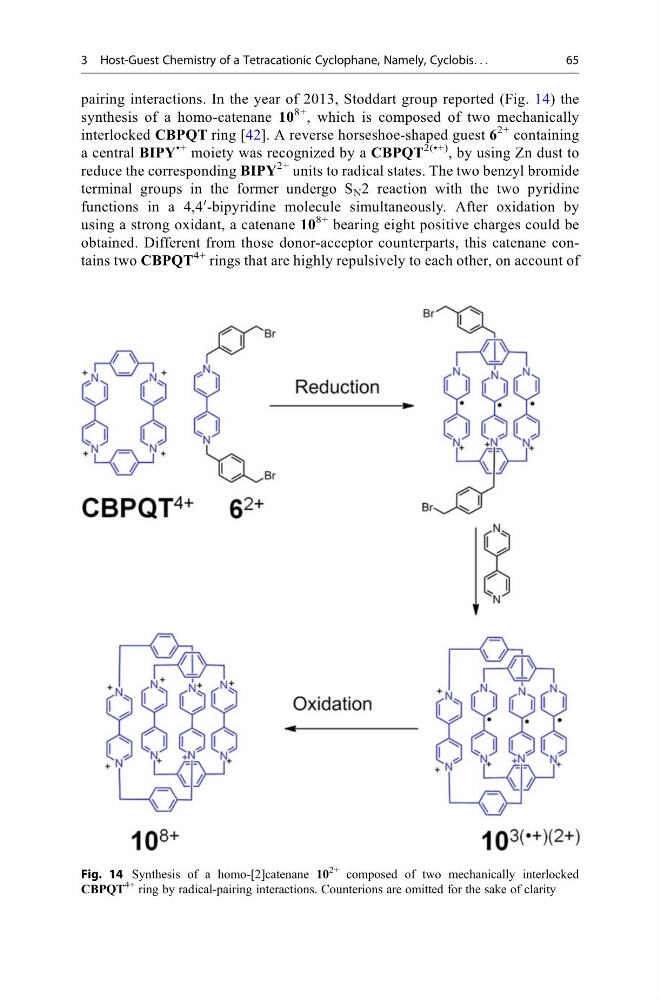
pairing interactions. In the year of 2013, Stoddart group reported (Fig. 14) the
synthesis of a homo-catenane 10
8+ , which is composed of two mechanically
interlocked CBPQT ring [42]. A reverse horseshoe-shaped guest 6
2+ containing
a central BIPY
•+ moiety was recognized by a CBPQT
2(•+) , by using Zn dust to
reduce the corresponding BIPY
2+ units to radical states. The two benzyl bromide
terminal groups in the former undergo S N 2 reaction with the two pyridine
functions in a 4,4
0 -bipyridine molecule simultaneously. After oxidation by
using a strong oxidant, a catenane 10
8+ bearing eight positive charges could be
obtained. Different from those donor-acceptor counterparts, this catenane contains two CBPQT
4+ rings that are highly repulsively to each other, on account of
Fig. 14 Synthesis of a homo-[2]catenane 10
2+ composed of two mechanically interlocked
CBPQT
4+ ring by radical-pairing interactions. Counterions are omitted for the sake of clarity
3 Host-Guest Chemistry of a Tetracationic Cyclophane, Namely, Cyclobis. . .
65
synthesis of a homo-catenane 10
8+ , which is composed of two mechanically
interlocked CBPQT ring [42]. A reverse horseshoe-shaped guest 6
2+ containing
a central BIPY
•+ moiety was recognized by a CBPQT
2(•+) , by using Zn dust to
reduce the corresponding BIPY
2+ units to radical states. The two benzyl bromide
terminal groups in the former undergo S N 2 reaction with the two pyridine
functions in a 4,4
0 -bipyridine molecule simultaneously. After oxidation by
using a strong oxidant, a catenane 10
8+ bearing eight positive charges could be
obtained. Different from those donor-acceptor counterparts, this catenane contains two CBPQT
4+ rings that are highly repulsively to each other, on account of
Fig. 14 Synthesis of a homo-[2]catenane 10
2+ composed of two mechanically interlocked
CBPQT
4+ ring by radical-pairing interactions. Counterions are omitted for the sake of clarity
3 Host-Guest Chemistry of a Tetracationic Cyclophane, Namely, Cyclobis. . .
65