

the host-guest recognition, even although hydrogen-bonding interactions are
weakened in these cases. This hypothesis is supported by the stronger K a for the
macrocycle to accommodate the guest BHEEN in water than that in MeCN
(see Fig. 7).
3.4.2 Guest Recognition Ability of CBPQT
2(•+)
One of the reduced states of CBPQT
4+
, namely, the bisradical dicationic CBPQT
2(•+)
,
contains two BIPY
•+ radical cations. Different from the BIPY
2+ contains an empty
LUMO that affords BIPY
2+ the ability to function as a π-electron acceptor, the SOMO
of a BIPY
•+ already contains an electron. As a consequence, BIPY
•+ is not capable of
undergoing donor-acceptor interactions with π-electron donors. Instead, BIPY
•+
undergoes a type of homo-loving interactions, namely, radical-pairing interactions
[31]. That is, the two SOMOs of two BIPY
•+ undergo efficient overlapping, forming
a set of two larger delocalized molecular orbitals of a (BIPY
•+
) 2 dimer. The two radical
electrons thus occupy the newly formed HOMO of the (BIPY
•+
) 2 dimer and therefore
get spin paired. The formation of the diamagnetic (BIPY
•+
) 2 dimer could be proven by
the observation that a solution of BIPY
•+ has clear EPR signal in the condition of low
concentration and/or higher temperature, while in the condition of higher concentration
and/or lower temperature, the EPR signal becomes weaker or even silent in some cases.
The behavior that two identical aromatic radicals get spin paired by means of π-π
stacking was also observed in a few of other aromatic radical systems, including
TTF
•+ radical cation [32] and naphthalene-1,8:4,5-bis(dicarboximide) (NDI
•À
) radical
anion [33].
In the case of CBPQT
2(•+) , spin pairing does not occur to its two BIPY
•+ units,
because their distance, namely, 7 Å, is too large to allow the occurrence of radical
spin pairing by means of π-π interactions, given that the efficient π-π interaction
distance is around 3.5 Å. Instead, when a BIPY
•+ guest inserts within the cavity,
the guest is able to undergo spin-pairing interactions with both of the two BIPY
•+
units in the macrocycle simultaneously, forming a BIPY
•+
&CBPQT
2(•+) complex [21, 34] (Fig. 10). Because the formation of BIPY
•+
&CBPQT
2(•+) is driven
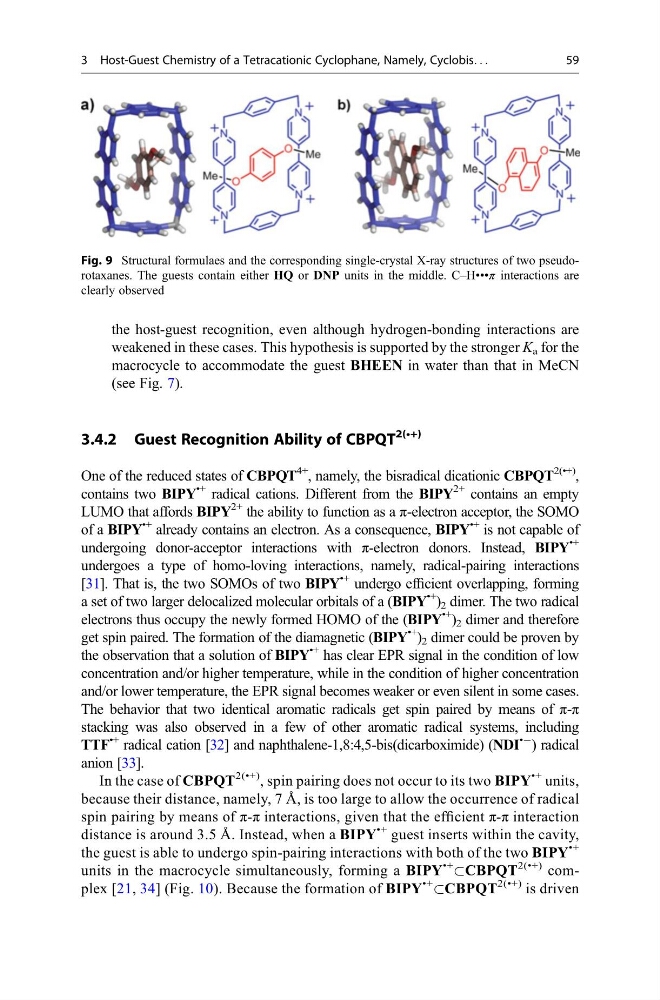
Fig. 9 Structural formulaes and the corresponding single-crystal X-ray structures of two pseudorotaxanes. The guests contain either HQ or DNP units in the middle. C–H•••π interactions are
clearly observed
3 Host-Guest Chemistry of a Tetracationic Cyclophane, Namely, Cyclobis. . .
59
weakened in these cases. This hypothesis is supported by the stronger K a for the
macrocycle to accommodate the guest BHEEN in water than that in MeCN
(see Fig. 7).
3.4.2 Guest Recognition Ability of CBPQT
2(•+)
One of the reduced states of CBPQT
4+
, namely, the bisradical dicationic CBPQT
2(•+)
,
contains two BIPY
•+ radical cations. Different from the BIPY
2+ contains an empty
LUMO that affords BIPY
2+ the ability to function as a π-electron acceptor, the SOMO
of a BIPY
•+ already contains an electron. As a consequence, BIPY
•+ is not capable of
undergoing donor-acceptor interactions with π-electron donors. Instead, BIPY
•+
undergoes a type of homo-loving interactions, namely, radical-pairing interactions
[31]. That is, the two SOMOs of two BIPY
•+ undergo efficient overlapping, forming
a set of two larger delocalized molecular orbitals of a (BIPY
•+
) 2 dimer. The two radical
electrons thus occupy the newly formed HOMO of the (BIPY
•+
) 2 dimer and therefore
get spin paired. The formation of the diamagnetic (BIPY
•+
) 2 dimer could be proven by
the observation that a solution of BIPY
•+ has clear EPR signal in the condition of low
concentration and/or higher temperature, while in the condition of higher concentration
and/or lower temperature, the EPR signal becomes weaker or even silent in some cases.
The behavior that two identical aromatic radicals get spin paired by means of π-π
stacking was also observed in a few of other aromatic radical systems, including
TTF
•+ radical cation [32] and naphthalene-1,8:4,5-bis(dicarboximide) (NDI
•À
) radical
anion [33].
In the case of CBPQT
2(•+) , spin pairing does not occur to its two BIPY
•+ units,
because their distance, namely, 7 Å, is too large to allow the occurrence of radical
spin pairing by means of π-π interactions, given that the efficient π-π interaction
distance is around 3.5 Å. Instead, when a BIPY
•+ guest inserts within the cavity,
the guest is able to undergo spin-pairing interactions with both of the two BIPY
•+
units in the macrocycle simultaneously, forming a BIPY
•+
&CBPQT
2(•+) complex [21, 34] (Fig. 10). Because the formation of BIPY
•+
&CBPQT
2(•+) is driven
Fig. 9 Structural formulaes and the corresponding single-crystal X-ray structures of two pseudorotaxanes. The guests contain either HQ or DNP units in the middle. C–H•••π interactions are
clearly observed
3 Host-Guest Chemistry of a Tetracationic Cyclophane, Namely, Cyclobis. . .
59