

by the formation of “dual” (BIPY
•+ ) 2 dimers or a (BIPY
•+ ) 3 trimer, the binding
constant K a (i.e., 10
5 M
À1
) is generally significantly larger than that of the (BIPY
•+
) 2
dimer.
The formation of BIPY
•+
&CBPQT
2(•+) has been convinced both experimentally and
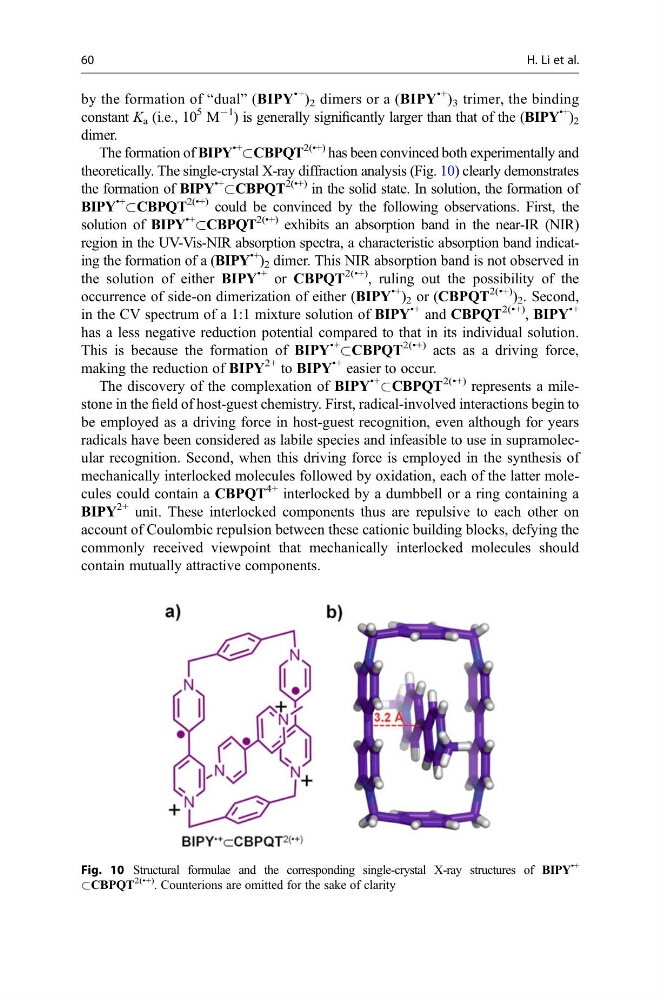
theoretically. The single-crystal X-ray diffraction analysis (Fig. 10) clearly demonstrates
the formation of BIPY
•+
&CBPQT
2(•+) in the solid state. In solution, the formation of
BIPY
•+
&CBPQT
2(•+) could be convinced by the following observations. First, the
solution of BIPY
•+
&CBPQT
2(•+) exhibits an absorption band in the near-IR (NIR)
region in the UV-Vis-NIR absorption spectra, a characteristic absorption band indicating the formation of a (BIPY
•+
) 2 dimer. This NIR absorption band is not observed in
the solution of either BIPY
•+ or CBPQT
2(•+) , ruling out the possibility of the
occurrence of side-on dimerization of either (BIPY
•+
) 2 or (CBPQT
2(•+) ) 2 . Second,
in the CV spectrum of a 1:1 mixture solution of BIPY
•+ and CBPQT
2(•+) , BIPY
•+
has a less negative reduction potential compared to that in its individual solution.
This is because the formation of BIPY
•+
&CBPQT
2(•+) acts as a driving force,
making the reduction of BIPY
2+ to BIPY
•+ easier to occur.
The discovery of the complexation of BIPY
•+
&CBPQT
2(•+) represents a milestone in the field of host-guest chemistry. First, radical-involved interactions begin to
be employed as a driving force in host-guest recognition, even although for years
radicals have been considered as labile species and infeasible to use in supramolecular recognition. Second, when this driving force is employed in the synthesis of
mechanically interlocked molecules followed by oxidation, each of the latter molecules could contain a CBPQT
4+ interlocked by a dumbbell or a ring containing a
BIPY
2+ unit. These interlocked components thus are repulsive to each other on
account of Coulombic repulsion between these cationic building blocks, defying the
commonly received viewpoint that mechanically interlocked molecules should
contain mutually attractive components.
Fig. 10 Structural formulae and the corresponding single-crystal X-ray structures of BIPY
•+
&CBPQT
2(•+)
. Counterions are omitted for the sake of clarity
60
H. Li et al.
•+ ) 2 dimers or a (BIPY
•+ ) 3 trimer, the binding
constant K a (i.e., 10
5 M
À1
) is generally significantly larger than that of the (BIPY
•+
) 2
dimer.
The formation of BIPY
•+
&CBPQT
2(•+) has been convinced both experimentally and
theoretically. The single-crystal X-ray diffraction analysis (Fig. 10) clearly demonstrates
the formation of BIPY
•+
&CBPQT
2(•+) in the solid state. In solution, the formation of
BIPY
•+
&CBPQT
2(•+) could be convinced by the following observations. First, the
solution of BIPY
•+
&CBPQT
2(•+) exhibits an absorption band in the near-IR (NIR)
region in the UV-Vis-NIR absorption spectra, a characteristic absorption band indicating the formation of a (BIPY
•+
) 2 dimer. This NIR absorption band is not observed in
the solution of either BIPY
•+ or CBPQT
2(•+) , ruling out the possibility of the
occurrence of side-on dimerization of either (BIPY
•+
) 2 or (CBPQT
2(•+) ) 2 . Second,
in the CV spectrum of a 1:1 mixture solution of BIPY
•+ and CBPQT
2(•+) , BIPY
•+
has a less negative reduction potential compared to that in its individual solution.
This is because the formation of BIPY
•+
&CBPQT
2(•+) acts as a driving force,
making the reduction of BIPY
2+ to BIPY
•+ easier to occur.
The discovery of the complexation of BIPY
•+
&CBPQT
2(•+) represents a milestone in the field of host-guest chemistry. First, radical-involved interactions begin to
be employed as a driving force in host-guest recognition, even although for years
radicals have been considered as labile species and infeasible to use in supramolecular recognition. Second, when this driving force is employed in the synthesis of
mechanically interlocked molecules followed by oxidation, each of the latter molecules could contain a CBPQT
4+ interlocked by a dumbbell or a ring containing a
BIPY
2+ unit. These interlocked components thus are repulsive to each other on
account of Coulombic repulsion between these cationic building blocks, defying the
commonly received viewpoint that mechanically interlocked molecules should
contain mutually attractive components.
Fig. 10 Structural formulae and the corresponding single-crystal X-ray structures of BIPY
•+
&CBPQT
2(•+)
. Counterions are omitted for the sake of clarity
60
H. Li et al.