

In addition, the difference in binding constants (K a ) for the guests bearing
different π-electron moieties also reveals the occurrence and importance of π–π
donor-acceptor interactions in guest recognition. For example, K a of the guests
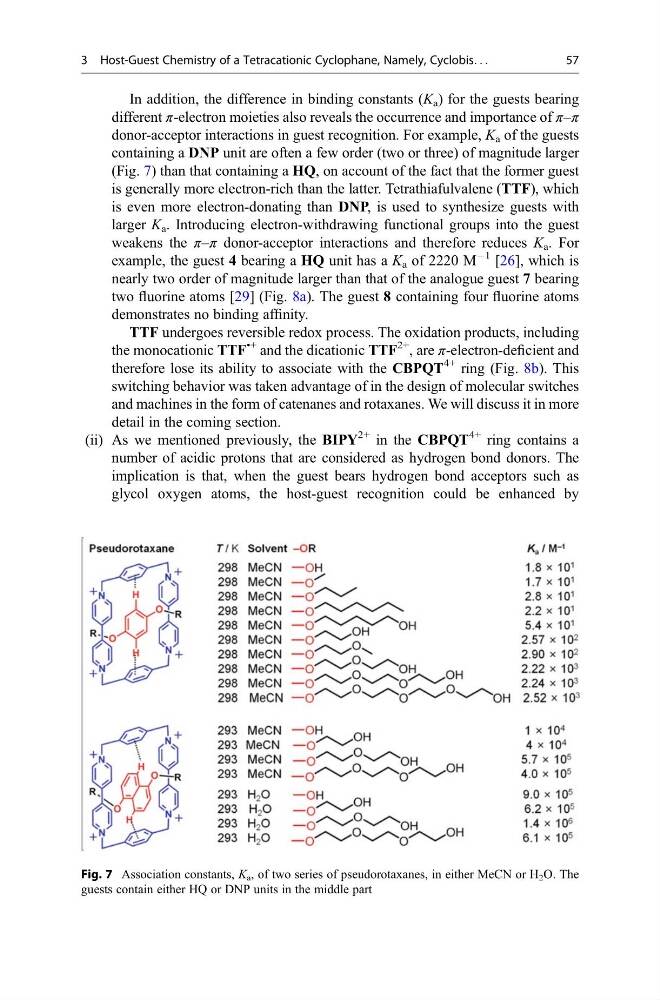
containing a DNP unit are often a few order (two or three) of magnitude larger
(Fig. 7) than that containing a HQ, on account of the fact that the former guest
is generally more electron-rich than the latter. Tetrathiafulvalene (TTF), which
is even more electron-donating than DNP, is used to synthesize guests with
larger K a . Introducing electron-withdrawing functional groups into the guest
weakens the π–π donor-acceptor interactions and therefore reduces K a . For
example, the guest 4 bearing a HQ unit has a K a of 2220 M
À1 [26], which is
nearly two order of magnitude larger than that of the analogue guest 7 bearing
two fluorine atoms [29] (Fig. 8a). The guest 8 containing four fluorine atoms
demonstrates no binding affinity.
TTF undergoes reversible redox process. The oxidation products, including
the monocationic TTF
•+ and the dicationic TTF
2+ , are π-electron-deficient and
therefore lose its ability to associate with the CBPQT
4+ ring (Fig. 8b). This
switching behavior was taken advantage of in the design of molecular switches
and machines in the form of catenanes and rotaxanes. We will discuss it in more
detail in the coming section.
(ii) As we mentioned previously, the BIPY
2+ in the CBPQT
4+ ring contains a
number of acidic protons that are considered as hydrogen bond donors. The
implication is that, when the guest bears hydrogen bond acceptors such as
glycol oxygen atoms, the host-guest recognition could be enhanced by
Fig. 7 Association constants, K a , of two series of pseudorotaxanes, in either MeCN or H 2 O. The
guests contain either HQ or DNP units in the middle part
3 Host-Guest Chemistry of a Tetracationic Cyclophane, Namely, Cyclobis. . .
57
different π-electron moieties also reveals the occurrence and importance of π–π
donor-acceptor interactions in guest recognition. For example, K a of the guests
containing a DNP unit are often a few order (two or three) of magnitude larger
(Fig. 7) than that containing a HQ, on account of the fact that the former guest
is generally more electron-rich than the latter. Tetrathiafulvalene (TTF), which
is even more electron-donating than DNP, is used to synthesize guests with
larger K a . Introducing electron-withdrawing functional groups into the guest
weakens the π–π donor-acceptor interactions and therefore reduces K a . For
example, the guest 4 bearing a HQ unit has a K a of 2220 M
À1 [26], which is
nearly two order of magnitude larger than that of the analogue guest 7 bearing
two fluorine atoms [29] (Fig. 8a). The guest 8 containing four fluorine atoms
demonstrates no binding affinity.
TTF undergoes reversible redox process. The oxidation products, including
the monocationic TTF
•+ and the dicationic TTF
2+ , are π-electron-deficient and
therefore lose its ability to associate with the CBPQT
4+ ring (Fig. 8b). This
switching behavior was taken advantage of in the design of molecular switches
and machines in the form of catenanes and rotaxanes. We will discuss it in more
detail in the coming section.
(ii) As we mentioned previously, the BIPY
2+ in the CBPQT
4+ ring contains a
number of acidic protons that are considered as hydrogen bond donors. The
implication is that, when the guest bears hydrogen bond acceptors such as
glycol oxygen atoms, the host-guest recognition could be enhanced by
Fig. 7 Association constants, K a , of two series of pseudorotaxanes, in either MeCN or H 2 O. The
guests contain either HQ or DNP units in the middle part
3 Host-Guest Chemistry of a Tetracationic Cyclophane, Namely, Cyclobis. . .
57