

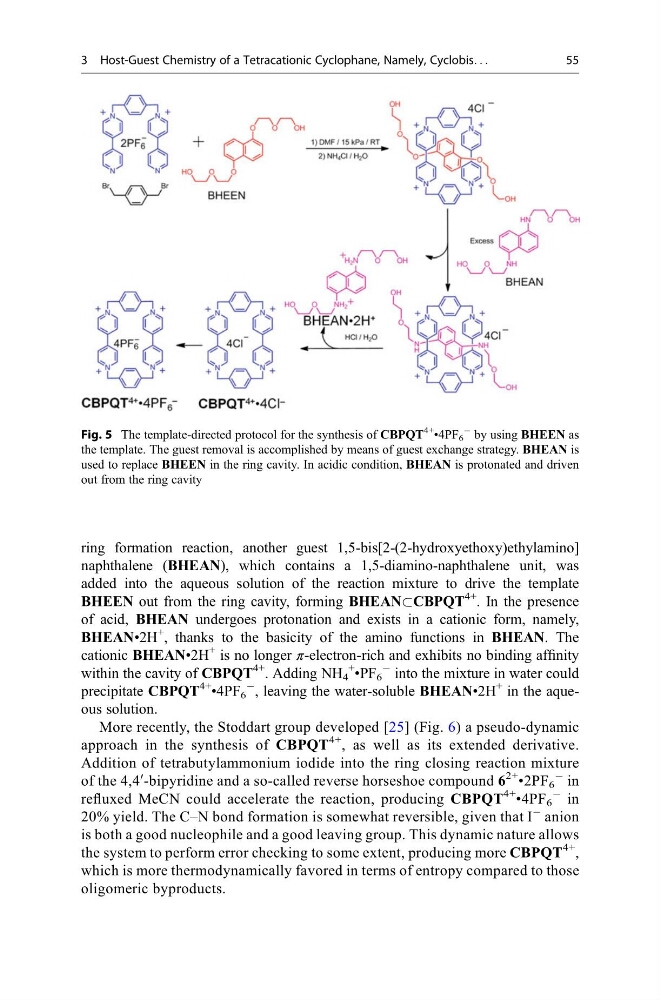
ring formation reaction, another guest 1,5-bis[2-(2-hydroxyethoxy)ethylamino]
naphthalene (BHEAN), which contains a 1,5-diamino-naphthalene unit, was
added into the aqueous solution of the reaction mixture to drive the template
BHEEN out from the ring cavity, forming BHEAN&CBPQT
4+ . In the presence
of acid, BHEAN undergoes protonation and exists in a cationic form, namely,
BHEAN•2H
+
, thanks to the basicity of the amino functions in BHEAN. The
cationic BHEAN•2H
+ is no longer π-electron-rich and exhibits no binding affinity
within the cavity of CBPQT
4+ . Adding NH 4
+
•PF 6
À into the mixture in water could
precipitate CBPQT
4+
•4PF 6
À , leaving the water-soluble BHEAN•2H
+ in the aqueous solution.
More recently, the Stoddart group developed [25] (Fig. 6) a pseudo-dynamic
approach in the synthesis of CBPQT
4+ , as well as its extended derivative.
Addition of tetrabutylammonium iodide into the ring closing reaction mixture
of the 4,4
0 -bipyridine and a so-called reverse horseshoe compound 6
2+
•2PF 6
À in
refluxed MeCN could accelerate the reaction, producing CBPQT
4+
•4PF 6
À in
20% yield. The C–N bond formation is somewhat reversible, given that I
À anion
is both a good nucleophile and a good leaving group. This dynamic nature allows
the system to perform error checking to some extent, producing more CBPQT
4+ ,
which is more thermodynamically favored in terms of entropy compared to those
oligomeric byproducts.
Fig. 5 The template-directed protocol for the synthesis of CBPQT
4+ •4PF 6
À by using BHEEN as
the template. The guest removal is accomplished by means of guest exchange strategy. BHEAN is
used to replace BHEEN in the ring cavity. In acidic condition, BHEAN is protonated and driven
out from the ring cavity
3 Host-Guest Chemistry of a Tetracationic Cyclophane, Namely, Cyclobis. . .
55
naphthalene (BHEAN), which contains a 1,5-diamino-naphthalene unit, was
added into the aqueous solution of the reaction mixture to drive the template
BHEEN out from the ring cavity, forming BHEAN&CBPQT
4+ . In the presence
of acid, BHEAN undergoes protonation and exists in a cationic form, namely,
BHEAN•2H
+
, thanks to the basicity of the amino functions in BHEAN. The
cationic BHEAN•2H
+ is no longer π-electron-rich and exhibits no binding affinity
within the cavity of CBPQT
4+ . Adding NH 4
+
•PF 6
À into the mixture in water could
precipitate CBPQT
4+
•4PF 6
À , leaving the water-soluble BHEAN•2H
+ in the aqueous solution.
More recently, the Stoddart group developed [25] (Fig. 6) a pseudo-dynamic
approach in the synthesis of CBPQT
4+ , as well as its extended derivative.
Addition of tetrabutylammonium iodide into the ring closing reaction mixture
of the 4,4
0 -bipyridine and a so-called reverse horseshoe compound 6
2+
•2PF 6
À in
refluxed MeCN could accelerate the reaction, producing CBPQT
4+
•4PF 6
À in
20% yield. The C–N bond formation is somewhat reversible, given that I
À anion
is both a good nucleophile and a good leaving group. This dynamic nature allows
the system to perform error checking to some extent, producing more CBPQT
4+ ,
which is more thermodynamically favored in terms of entropy compared to those
oligomeric byproducts.
Fig. 5 The template-directed protocol for the synthesis of CBPQT
4+ •4PF 6
À by using BHEEN as
the template. The guest removal is accomplished by means of guest exchange strategy. BHEAN is
used to replace BHEEN in the ring cavity. In acidic condition, BHEAN is protonated and driven
out from the ring cavity
3 Host-Guest Chemistry of a Tetracationic Cyclophane, Namely, Cyclobis. . .
55