

reverse the constitutionally roles of the host and guest, by introducing two BIPY
2+
units into a macrocycle, namely, CBPQT
4+ , which was supposed to bind a πelectron-rich guest including a HQ derivative 2.
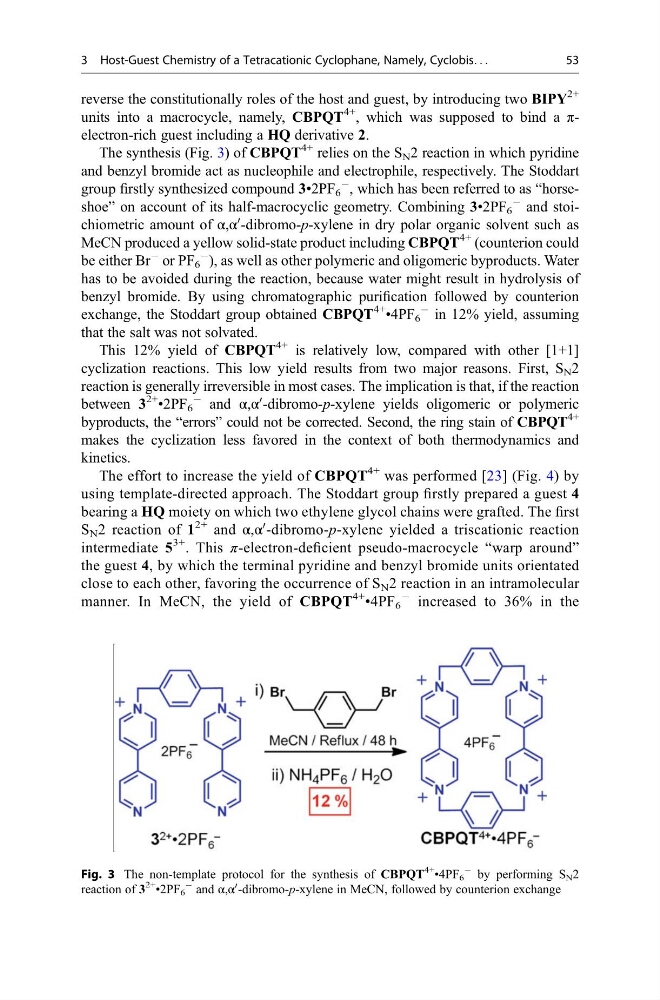
The synthesis (Fig. 3) of CBPQT
4+ relies on the S N 2 reaction in which pyridine
and benzyl bromide act as nucleophile and electrophile, respectively. The Stoddart
group firstly synthesized compound 3•2PF 6
À , which has been referred to as “horseshoe” on account of its half-macrocyclic geometry. Combining 3•2PF 6
À and stoichiometric amount of α,α
0 -dibromo-p-xylene in dry polar organic solvent such as
MeCN produced a yellow solid-state product including CBPQT
4+ (counterion could
be either Br
À or PF 6
À ), as well as other polymeric and oligomeric byproducts. Water
has to be avoided during the reaction, because water might result in hydrolysis of
benzyl bromide. By using chromatographic purification followed by counterion
exchange, the Stoddart group obtained CBPQT
4+
•4PF 6
À in 12% yield, assuming
that the salt was not solvated.
This 12% yield of CBPQT
4+ is relatively low, compared with other [1+1]
cyclization reactions. This low yield results from two major reasons. First, S N 2
reaction is generally irreversible in most cases. The implication is that, if the reaction
between 3
2+
•2PF 6
À and α,α
0 -dibromo-p-xylene yields oligomeric or polymeric
byproducts, the “errors” could not be corrected. Second, the ring stain of CBPQT
4+
makes the cyclization less favored in the context of both thermodynamics and
kinetics.
The effort to increase the yield of CBPQT
4+ was performed [23] (Fig. 4) by
using template-directed approach. The Stoddart group firstly prepared a guest 4
bearing a HQ moiety on which two ethylene glycol chains were grafted. The first
S N 2 reaction of 1
2+ and α,α
0 -dibromo-p-xylene yielded a triscationic reaction
intermediate 5
3+ . This π-electron-deficient pseudo-macrocycle “warp around”
the guest 4, by which the terminal pyridine and benzyl bromide units orientated
close to each other, favoring the occurrence of S N 2 reaction in an intramolecular
manner. In MeCN, the yield of CBPQT
4+
•4PF 6
À increased to 36% in the
Fig. 3 The non-template protocol for the synthesis of CBPQT
4+ •4PF 6
À by performing S N 2
reaction of 3
2+ •2PF 6
À and α,α
0 -dibromo-p-xylene in MeCN, followed by counterion exchange
3 Host-Guest Chemistry of a Tetracationic Cyclophane, Namely, Cyclobis. . .
53
2+
units into a macrocycle, namely, CBPQT
4+ , which was supposed to bind a πelectron-rich guest including a HQ derivative 2.
The synthesis (Fig. 3) of CBPQT
4+ relies on the S N 2 reaction in which pyridine
and benzyl bromide act as nucleophile and electrophile, respectively. The Stoddart
group firstly synthesized compound 3•2PF 6
À , which has been referred to as “horseshoe” on account of its half-macrocyclic geometry. Combining 3•2PF 6
À and stoichiometric amount of α,α
0 -dibromo-p-xylene in dry polar organic solvent such as
MeCN produced a yellow solid-state product including CBPQT
4+ (counterion could
be either Br
À or PF 6
À ), as well as other polymeric and oligomeric byproducts. Water
has to be avoided during the reaction, because water might result in hydrolysis of
benzyl bromide. By using chromatographic purification followed by counterion
exchange, the Stoddart group obtained CBPQT
4+
•4PF 6
À in 12% yield, assuming
that the salt was not solvated.
This 12% yield of CBPQT
4+ is relatively low, compared with other [1+1]
cyclization reactions. This low yield results from two major reasons. First, S N 2
reaction is generally irreversible in most cases. The implication is that, if the reaction
between 3
2+
•2PF 6
À and α,α
0 -dibromo-p-xylene yields oligomeric or polymeric
byproducts, the “errors” could not be corrected. Second, the ring stain of CBPQT
4+
makes the cyclization less favored in the context of both thermodynamics and
kinetics.
The effort to increase the yield of CBPQT
4+ was performed [23] (Fig. 4) by
using template-directed approach. The Stoddart group firstly prepared a guest 4
bearing a HQ moiety on which two ethylene glycol chains were grafted. The first
S N 2 reaction of 1
2+ and α,α
0 -dibromo-p-xylene yielded a triscationic reaction
intermediate 5
3+ . This π-electron-deficient pseudo-macrocycle “warp around”
the guest 4, by which the terminal pyridine and benzyl bromide units orientated
close to each other, favoring the occurrence of S N 2 reaction in an intramolecular
manner. In MeCN, the yield of CBPQT
4+
•4PF 6
À increased to 36% in the
Fig. 3 The non-template protocol for the synthesis of CBPQT
4+ •4PF 6
À by performing S N 2
reaction of 3
2+ •2PF 6
À and α,α
0 -dibromo-p-xylene in MeCN, followed by counterion exchange
3 Host-Guest Chemistry of a Tetracationic Cyclophane, Namely, Cyclobis. . .
53