

which supports our aforementioned hypothesis that these aromatic building blocks in
the CBPQT
4+ framework have bent conformation.
The CBPQT
4+ ring has an amphiphilic nature, i.e., its cationic BIPY
2+ and the
neutral p-xylyl building blocks are hydrophilic and hydrophobic, respectively.
Therefore, the solubility of this tetracationic cyclophane is often determined by its
counterions. When the counterions are less polar and hydrophobic PF 6
À or BF 4
À
, the
salts, namely, CBPQT
4+
•4PF 6
À or CBPQT
4+
•4BF 4
À
, are soluble in polar organic
solvents, such as MeCN, DMF, and MeNO 2 . When the counterions are changed to
those that are highly solvated in water, including Cl
À , Br
À
, or NO 3
À , the cyclophane
becomes soluble in water.
3.3
Synthesis
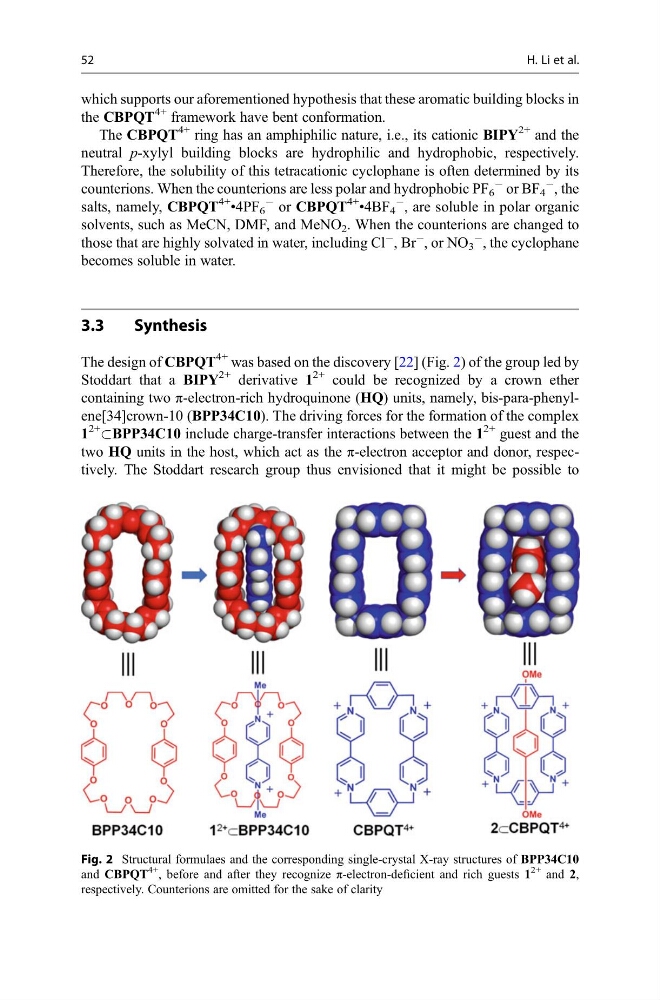
The design of CBPQT
4+ was based on the discovery [22] (Fig. 2) of the group led by
Stoddart that a BIPY
2+ derivative 1
2+ could be recognized by a crown ether
containing two π-electron-rich hydroquinone (HQ) units, namely, bis-para-phenylene[34]crown-10 (BPP34C10). The driving forces for the formation of the complex
1
2+
&BPP34C10 include charge-transfer interactions between the 1
2+ guest and the
two HQ units in the host, which act as the π-electron acceptor and donor, respectively. The Stoddart research group thus envisioned that it might be possible to
Fig. 2 Structural formulaes and the corresponding single-crystal X-ray structures of BPP34C10
and CBPQT
4+ , before and after they recognize π-electron-deficient and rich guests 1
2+ and 2,
respectively. Counterions are omitted for the sake of clarity
52
H. Li et al.
the CBPQT
4+ framework have bent conformation.
The CBPQT
4+ ring has an amphiphilic nature, i.e., its cationic BIPY
2+ and the
neutral p-xylyl building blocks are hydrophilic and hydrophobic, respectively.
Therefore, the solubility of this tetracationic cyclophane is often determined by its
counterions. When the counterions are less polar and hydrophobic PF 6
À or BF 4
À
, the
salts, namely, CBPQT
4+
•4PF 6
À or CBPQT
4+
•4BF 4
À
, are soluble in polar organic
solvents, such as MeCN, DMF, and MeNO 2 . When the counterions are changed to
those that are highly solvated in water, including Cl
À , Br
À
, or NO 3
À , the cyclophane
becomes soluble in water.
3.3
Synthesis
The design of CBPQT
4+ was based on the discovery [22] (Fig. 2) of the group led by
Stoddart that a BIPY
2+ derivative 1
2+ could be recognized by a crown ether
containing two π-electron-rich hydroquinone (HQ) units, namely, bis-para-phenylene[34]crown-10 (BPP34C10). The driving forces for the formation of the complex
1
2+
&BPP34C10 include charge-transfer interactions between the 1
2+ guest and the
two HQ units in the host, which act as the π-electron acceptor and donor, respectively. The Stoddart research group thus envisioned that it might be possible to
Fig. 2 Structural formulaes and the corresponding single-crystal X-ray structures of BPP34C10
and CBPQT
4+ , before and after they recognize π-electron-deficient and rich guests 1
2+ and 2,
respectively. Counterions are omitted for the sake of clarity
52
H. Li et al.