

used to trigger the “turn on” of therapeutic effect. As a proof-of-concept demonstration, this work showed that guest displacement could be an efficient strategy to turn
on therapeutic effect on demand. These host-guest chemistry-based stimuli are
orthogonal to other chemical or physical stimuli and may be used for sophisticated
drug delivery applications.
Similar design was used as bioorthogonal interaction to switch on catalysis in
cells. Nanoreactors are important for chemical production and biological catalysis.
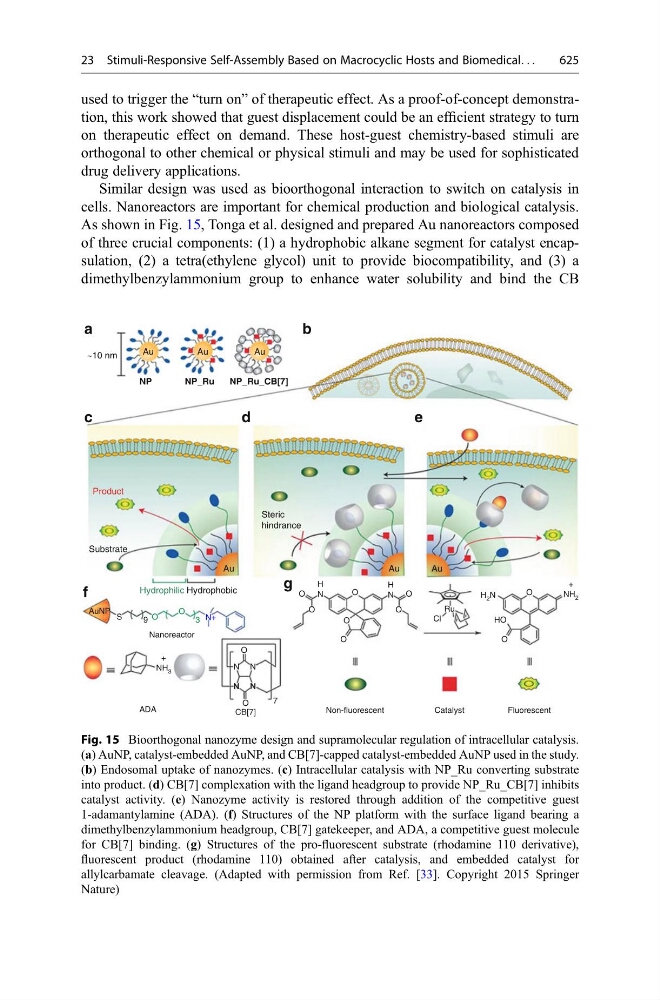
As shown in Fig. 15, Tonga et al. designed and prepared Au nanoreactors composed
of three crucial components: (1) a hydrophobic alkane segment for catalyst encapsulation, (2) a tetra(ethylene glycol) unit to provide biocompatibility, and (3) a
dimethylbenzylammonium group to enhance water solubility and bind the CB
~10 nm
Au
Au
Au
Steric
hindrance
AuNP
+
NH 3
ADA
CB[7]
Non-fluorescent
Catalyst
Fluorescent
O
O
O
O
O
O
O
O
Cl
Ru
HO
O
O
+
NH 2
H 2 N
O
H
N
H
N
N
N
N
N
7
Nanoreactor
S
9 O
O
3 N+
Au
Au
Au
Substrate
Hydrophilic Hydrophobic
Product
b
a
c
d
e
f
g
NP
NP_Ru
NP_Ru_CB[7]
Fig. 15 Bioorthogonal nanozyme design and supramolecular regulation of intracellular catalysis.
(a) AuNP, catalyst-embedded AuNP, and CB[7]-capped catalyst-embedded AuNP used in the study.
(b) Endosomal uptake of nanozymes. (c) Intracellular catalysis with NP_Ru converting substrate
into product. (d) CB[7] complexation with the ligand headgroup to provide NP_Ru_CB[7] inhibits
catalyst activity. (e) Nanozyme activity is restored through addition of the competitive guest
1-adamantylamine (ADA). (f) Structures of the NP platform with the surface ligand bearing a
dimethylbenzylammonium headgroup, CB[7] gatekeeper, and ADA, a competitive guest molecule
for CB[7] binding. (g) Structures of the pro-fluorescent substrate (rhodamine 110 derivative),
fluorescent product (rhodamine 110) obtained after catalysis, and embedded catalyst for
allylcarbamate cleavage. (Adapted with permission from Ref. [33]. Copyright 2015 Springer
Nature)
23 Stimuli-Responsive Self-Assembly Based on Macrocyclic Hosts and Biomedical. . .
625