

[7] gatekeeper [33]. Ruthenium-based catalyst was loaded into the hydrophobic
section of nanoreactors. CB[7] gatekeeper could prevent prodrugs from reaching
nanoreactor. When ADA was added as a bioorthogonal stimulus, CB[7] gatekeeper
was removed by host-guest interaction to expose the interior of nanoreactor. Model
dye and 5-fluorouracil-based prodrug were used in this study. Ru-based catalyst could
trigger the conversion from prodrug to active dye or drug. Cell study confirmed that
removal of CB[7] gatekeeper and biocatalysis led to fluorescence and cytotoxicity
in vitro. This proof-of-concept study demonstrated host-guest chemistry could be used
to control biocatalysis. As a bioorthogonal strategy to other chemical or physical
stimuli, this host-guest method could be used to turn on catalysis on demand.
Samanta et al. developed CB[8]-capped metal-organic polyhedron (MOP) for the
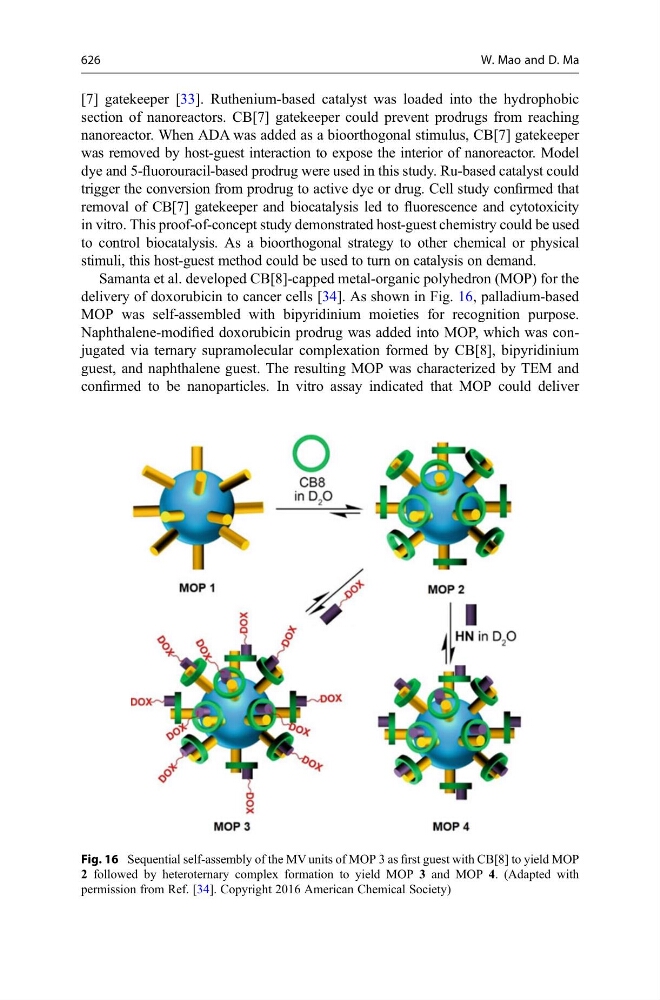
delivery of doxorubicin to cancer cells [34]. As shown in Fig. 16, palladium-based
MOP was self-assembled with bipyridinium moieties for recognition purpose.
Naphthalene-modified doxorubicin prodrug was added into MOP, which was conjugated via ternary supramolecular complexation formed by CB[8], bipyridinium
guest, and naphthalene guest. The resulting MOP was characterized by TEM and
confirmed to be nanoparticles. In vitro assay indicated that MOP could deliver
Fig. 16 Sequential self-assembly of the MV units of MOP 3 as first guest with CB[8] to yield MOP
2 followed by heteroternary complex formation to yield MOP 3 and MOP 4. (Adapted with
permission from Ref. [34]. Copyright 2016 American Chemical Society)
626
W. Mao and D. Ma