

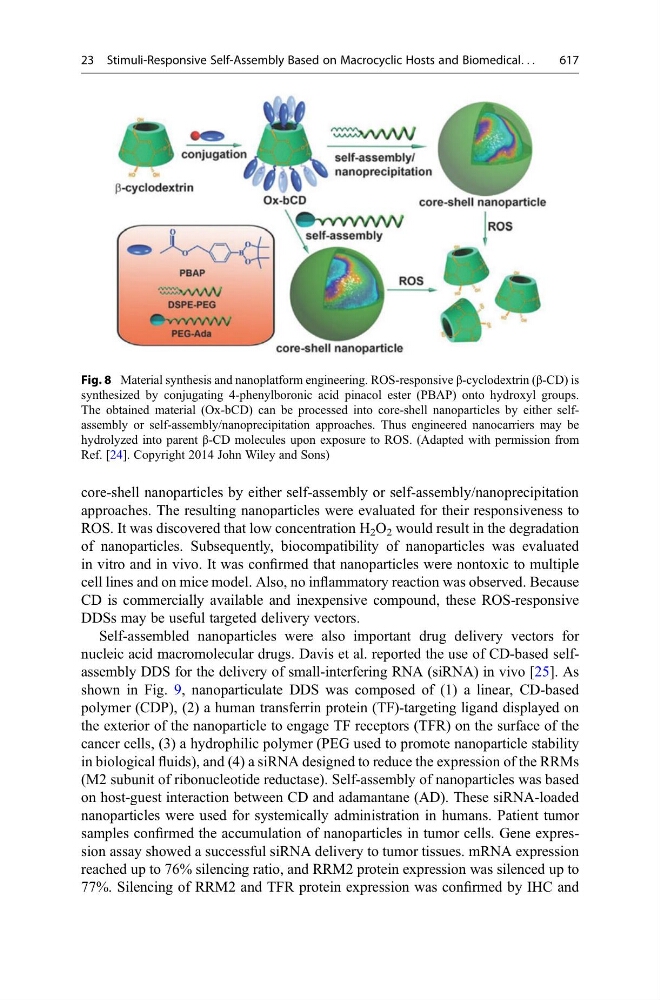
core-shell nanoparticles by either self-assembly or self-assembly/nanoprecipitation
approaches. The resulting nanoparticles were evaluated for their responsiveness to
ROS. It was discovered that low concentration H 2 O 2 would result in the degradation
of nanoparticles. Subsequently, biocompatibility of nanoparticles was evaluated
in vitro and in vivo. It was confirmed that nanoparticles were nontoxic to multiple
cell lines and on mice model. Also, no inflammatory reaction was observed. Because
CD is commercially available and inexpensive compound, these ROS-responsive
DDSs may be useful targeted delivery vectors.
Self-assembled nanoparticles were also important drug delivery vectors for
nucleic acid macromolecular drugs. Davis et al. reported the use of CD-based selfassembly DDS for the delivery of small-interfering RNA (siRNA) in vivo [25]. As
shown in Fig. 9, nanoparticulate DDS was composed of (1) a linear, CD-based
polymer (CDP), (2) a human transferrin protein (TF)-targeting ligand displayed on
the exterior of the nanoparticle to engage TF receptors (TFR) on the surface of the
cancer cells, (3) a hydrophilic polymer (PEG used to promote nanoparticle stability
in biological fluids), and (4) a siRNA designed to reduce the expression of the RRMs
(M2 subunit of ribonucleotide reductase). Self-assembly of nanoparticles was based
on host-guest interaction between CD and adamantane (AD). These siRNA-loaded
nanoparticles were used for systemically administration in humans. Patient tumor
samples confirmed the accumulation of nanoparticles in tumor cells. Gene expression assay showed a successful siRNA delivery to tumor tissues. mRNA expression
reached up to 76% silencing ratio, and RRM2 protein expression was silenced up to
77%. Silencing of RRM2 and TFR protein expression was confirmed by IHC and
Fig. 8 Material synthesis and nanoplatform engineering. ROS-responsive β-cyclodextrin (β-CD) is
synthesized by conjugating 4-phenylboronic acid pinacol ester (PBAP) onto hydroxyl groups.
The obtained material (Ox-bCD) can be processed into core-shell nanoparticles by either selfassembly or self-assembly/nanoprecipitation approaches. Thus engineered nanocarriers may be
hydrolyzed into parent β-CD molecules upon exposure to ROS. (Adapted with permission from
Ref. [24]. Copyright 2014 John Wiley and Sons)
23 Stimuli-Responsive Self-Assembly Based on Macrocyclic Hosts and Biomedical. . .
617