

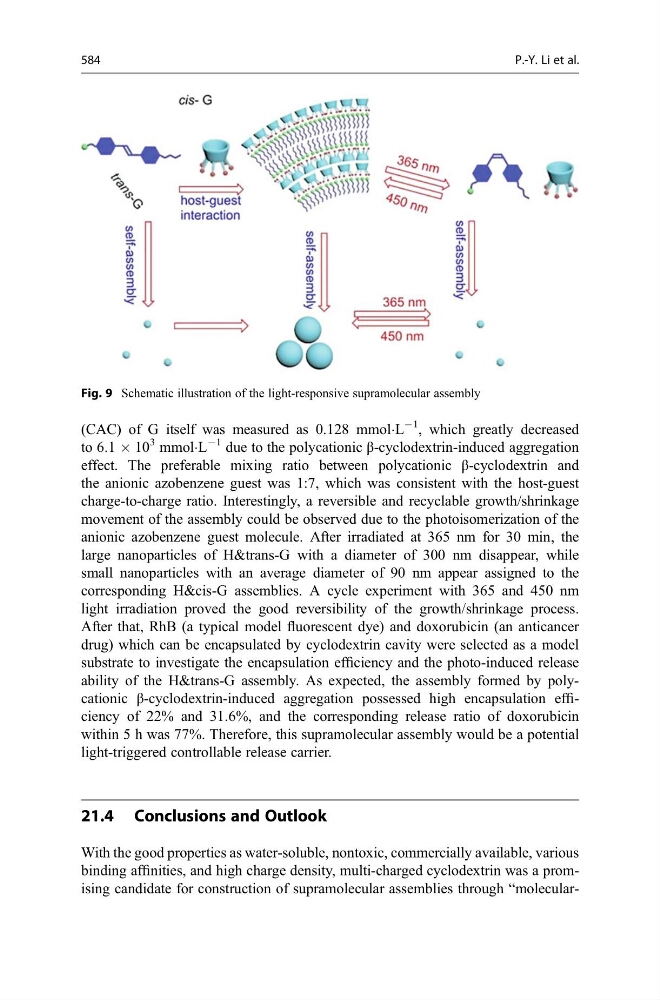
(CAC) of G itself was measured as 0.128 mmolÁL
À1 , which greatly decreased
to 6.1 Â 10
3 mmolÁL
À1 due to the polycationic β-cyclodextrin-induced aggregation
effect. The preferable mixing ratio between polycationic β-cyclodextrin and
the anionic azobenzene guest was 1:7, which was consistent with the host-guest
charge-to-charge ratio. Interestingly, a reversible and recyclable growth/shrinkage
movement of the assembly could be observed due to the photoisomerization of the
anionic azobenzene guest molecule. After irradiated at 365 nm for 30 min, the
large nanoparticles of H&trans-G with a diameter of 300 nm disappear, while
small nanoparticles with an average diameter of 90 nm appear assigned to the
corresponding H&cis-G assemblies. A cycle experiment with 365 and 450 nm
light irradiation proved the good reversibility of the growth/shrinkage process.
After that, RhB (a typical model fluorescent dye) and doxorubicin (an anticancer
drug) which can be encapsulated by cyclodextrin cavity were selected as a model
substrate to investigate the encapsulation efficiency and the photo-induced release
ability of the H&trans-G assembly. As expected, the assembly formed by polycationic β-cyclodextrin-induced aggregation possessed high encapsulation efficiency of 22% and 31.6%, and the corresponding release ratio of doxorubicin
within 5 h was 77%. Therefore, this supramolecular assembly would be a potential
light-triggered controllable release carrier.
21.4 Conclusions and Outlook
With the good properties as water-soluble, nontoxic, commercially available, various
binding affinities, and high charge density, multi-charged cyclodextrin was a promising candidate for construction of supramolecular assemblies through “molecularFig. 9 Schematic illustration of the light-responsive supramolecular assembly
584
P.-Y. Li et al.