

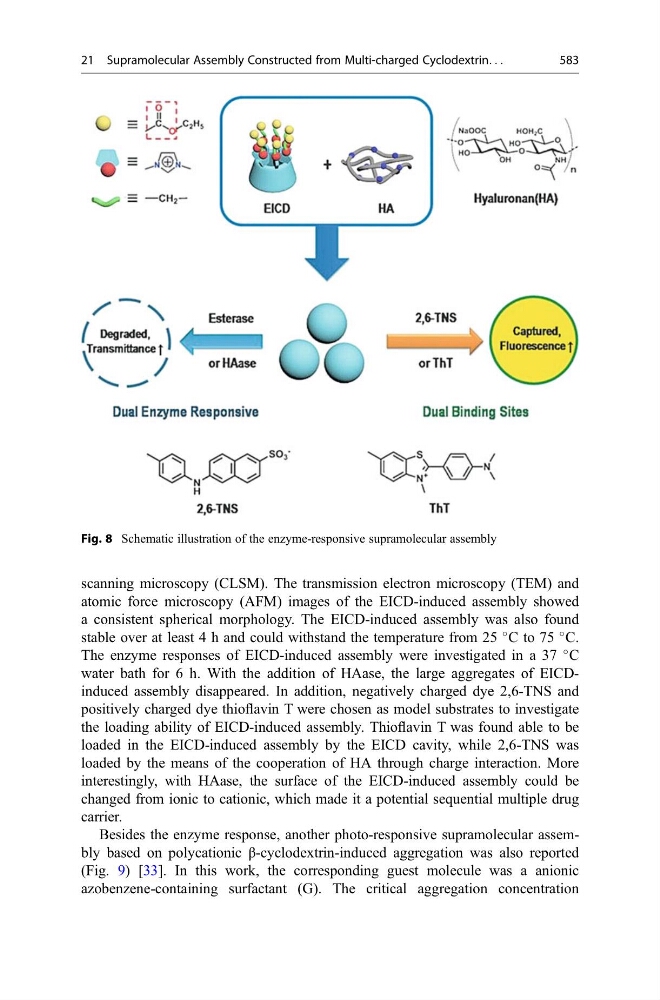
scanning microscopy (CLSM). The transmission electron microscopy (TEM) and
atomic force microscopy (AFM) images of the EICD-induced assembly showed
a consistent spherical morphology. The EICD-induced assembly was also found
stable over at least 4 h and could withstand the temperature from 25
C to 75
C.
The enzyme responses of EICD-induced assembly were investigated in a 37
C
water bath for 6 h. With the addition of HAase, the large aggregates of EICDinduced assembly disappeared. In addition, negatively charged dye 2,6-TNS and
positively charged dye thioflavin T were chosen as model substrates to investigate
the loading ability of EICD-induced assembly. Thioflavin T was found able to be
loaded in the EICD-induced assembly by the EICD cavity, while 2,6-TNS was
loaded by the means of the cooperation of HA through charge interaction. More
interestingly, with HAase, the surface of the EICD-induced assembly could be
changed from ionic to cationic, which made it a potential sequential multiple drug
carrier.
Besides the enzyme response, another photo-responsive supramolecular assembly based on polycationic β-cyclodextrin-induced aggregation was also reported
(Fig. 9) [33]. In this work, the corresponding guest molecule was a anionic
azobenzene-containing surfactant (G). The critical aggregation concentration
Fig. 8 Schematic illustration of the enzyme-responsive supramolecular assembly
21 Supramolecular Assembly Constructed from Multi-charged Cyclodextrin. . .
583