

self-aggregation of the guest molecule. 2D ROESY spectrum further confirmed
the assembly mechanism that G was gathered around H3 instead of being captured
by the H3 cavity. This also proved the importance of electrostatic interactions
in the molecular-induced aggregation. The H3@G assembly was also found to
be stable in the temperature between 25
C and 70
C. After that, a ternary assembly
H 3 @Ama@G was constructed in which a pharmacological drug for anti-Parkinson
and antiviral amantadine (Ama) was selected as model drug. The complexation
stoichiometry binding radio of 1:1 between H3 and Ama was confirmed
through the job analysis, and the apparent binding constant was 2.34 Â 10
4 M
À1 .
Then, the release behavior of the H 3 @Ama@G was investigated with trisodium
salt of 8-hydroxypyrene-1,3,6-trisulfonic acid (HPTS) chosen as the cargo. The
release rate of HPTS-loaded assemblies was much faster than that of the free
HPTS solution.
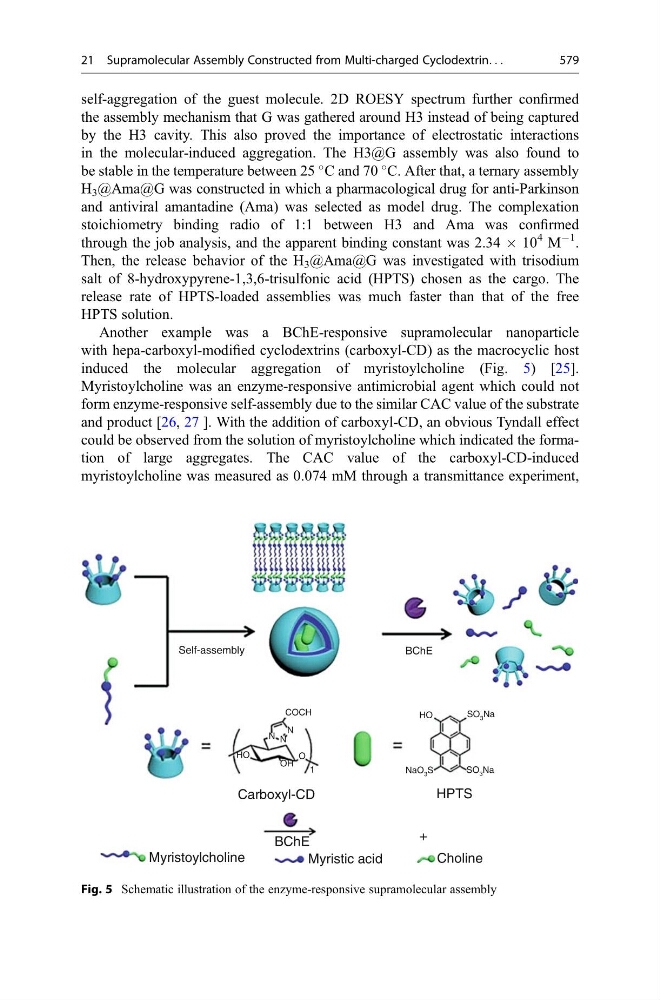
Another example was a BChE-responsive supramolecular nanoparticle
with hepa-carboxyl-modified cyclodextrins (carboxyl-CD) as the macrocyclic host
induced the molecular aggregation of myristoylcholine (Fig. 5) [25].
Myristoylcholine was an enzyme-responsive antimicrobial agent which could not
form enzyme-responsive self-assembly due to the similar CAC value of the substrate
and product [26, 27 ]. With the addition of carboxyl-CD, an obvious Tyndall effect
could be observed from the solution of myristoylcholine which indicated the formation of large aggregates. The CAC value of the carboxyl-CD-induced
myristoylcholine was measured as 0.074 mM through a transmittance experiment,
Self-assembly
BChE
HO
COCH
HO
OH
Carboxyl-CD
HPTS
BChE
Choline
+
Myristic acid
Myristoylcholine
N
N
N
O
1
SO 3 Na
SO 3 Na
NaO 3 S
Fig. 5 Schematic illustration of the enzyme-responsive supramolecular assembly
21 Supramolecular Assembly Constructed from Multi-charged Cyclodextrin. . .
579