

and the preferable mixing ratio was 1:7. The mechanism of the “carboxyl-CDinduced aggregation” may be summarized as follows: The myristoylcholine molecules did not form a large self-aggregate. With carboxyl-CD added, a complex
between one carboxyl-CD and several myristoylcholines was formed. Then, through
the hydrophobic interactions between the aliphatic tails of myristoylcholine, several
complexes integrated together to form a large aggregate and curved to a spherical
nanoparticles. The transmission electron microscopy (TEM) images showed a
spherical morphology with an average diameter around 200 nm which is consistent
with the hydrodynamic diameter of 288 nm measured by dynamic light scattering
(DLS). After treated with BChE, the optical transmittance of carboxyl-CD/
myristoylcholine increased to >95% in 2 h resulting from hydrolysis of the guests.
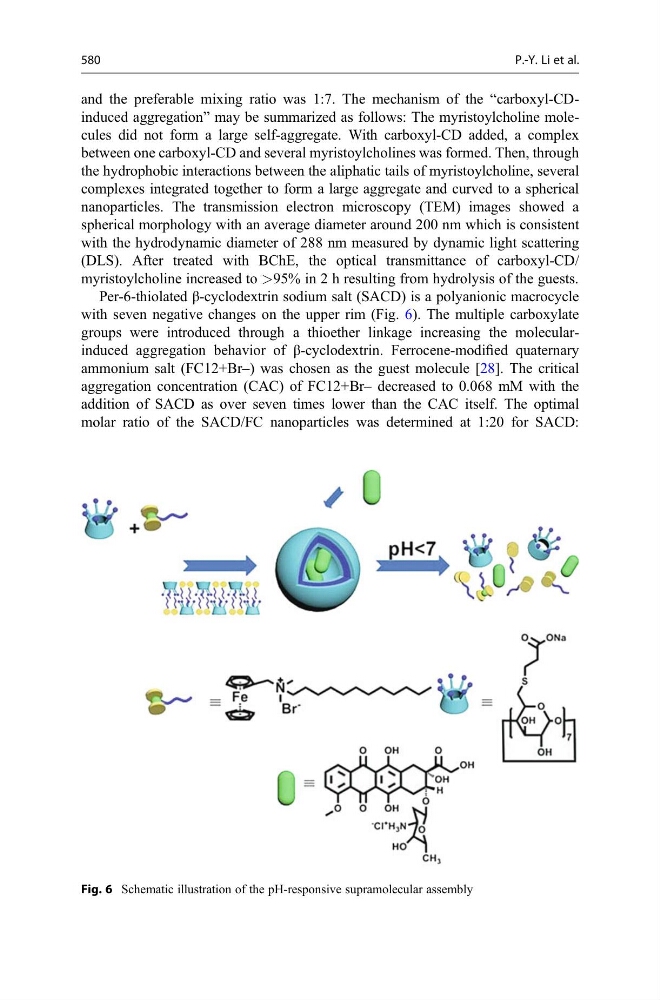
Per-6-thiolated β-cyclodextrin sodium salt (SACD) is a polyanionic macrocycle
with seven negative changes on the upper rim (Fig. 6). The multiple carboxylate
groups were introduced through a thioether linkage increasing the molecularinduced aggregation behavior of β-cyclodextrin. Ferrocene-modified quaternary
ammonium salt (FC12+Br–) was chosen as the guest molecule [28]. The critical
aggregation concentration (CAC) of FC12+Br– decreased to 0.068 mM with the
addition of SACD as over seven times lower than the CAC itself. The optimal
molar ratio of the SACD/FC nanoparticles was determined at 1:20 for SACD:
Fig. 6 Schematic illustration of the pH-responsive supramolecular assembly
580
P.-Y. Li et al.