

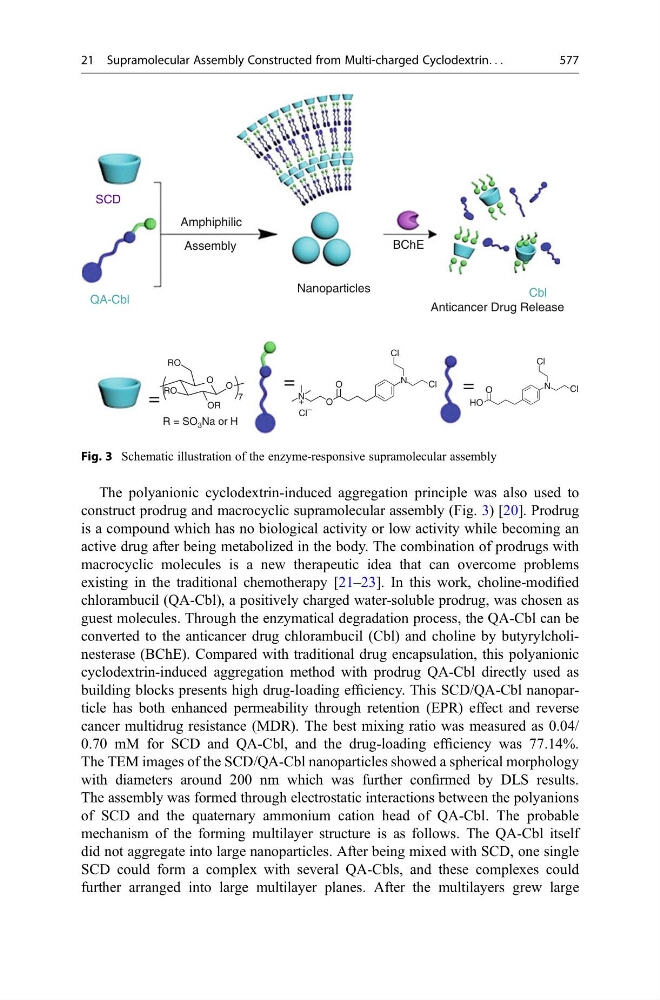
The polyanionic cyclodextrin-induced aggregation principle was also used to
construct prodrug and macrocyclic supramolecular assembly (Fig. 3) [20]. Prodrug
is a compound which has no biological activity or low activity while becoming an
active drug after being metabolized in the body. The combination of prodrugs with
macrocyclic molecules is a new therapeutic idea that can overcome problems
existing in the traditional chemotherapy [21–23]. In this work, choline-modified
chlorambucil (QA-Cbl), a positively charged water-soluble prodrug, was chosen as
guest molecules. Through the enzymatical degradation process, the QA-Cbl can be
converted to the anticancer drug chlorambucil (Cbl) and choline by butyrylcholinesterase (BChE). Compared with traditional drug encapsulation, this polyanionic
cyclodextrin-induced aggregation method with prodrug QA-Cbl directly used as
building blocks presents high drug-loading efficiency. This SCD/QA-Cbl nanoparticle has both enhanced permeability through retention (EPR) effect and reverse
cancer multidrug resistance (MDR). The best mixing ratio was measured as 0.04/
0.70 mM for SCD and QA-Cbl, and the drug-loading efficiency was 77.14%.
The TEM images of the SCD/QA-Cbl nanoparticles showed a spherical morphology
with diameters around 200 nm which was further confirmed by DLS results.
The assembly was formed through electrostatic interactions between the polyanions
of SCD and the quaternary ammonium cation head of QA-Cbl. The probable
mechanism of the forming multilayer structure is as follows. The QA-Cbl itself
did not aggregate into large nanoparticles. After being mixed with SCD, one single
SCD could form a complex with several QA-Cbls, and these complexes could
further arranged into large multilayer planes. After the multilayers grew large
SCD
Amphiphilic
Assembly
Nanoparticles
BChE
Anticancer Drug Release
QA-Cbl
Cbl
RO
RO
OR
Cl –
Cl
Cl
N
O
O
Cl
Cl
HO
O
N
N
+
7
R = SO 3 Na or H
=
=
=
O O
Fig. 3 Schematic illustration of the enzyme-responsive supramolecular assembly
21 Supramolecular Assembly Constructed from Multi-charged Cyclodextrin. . .
577