

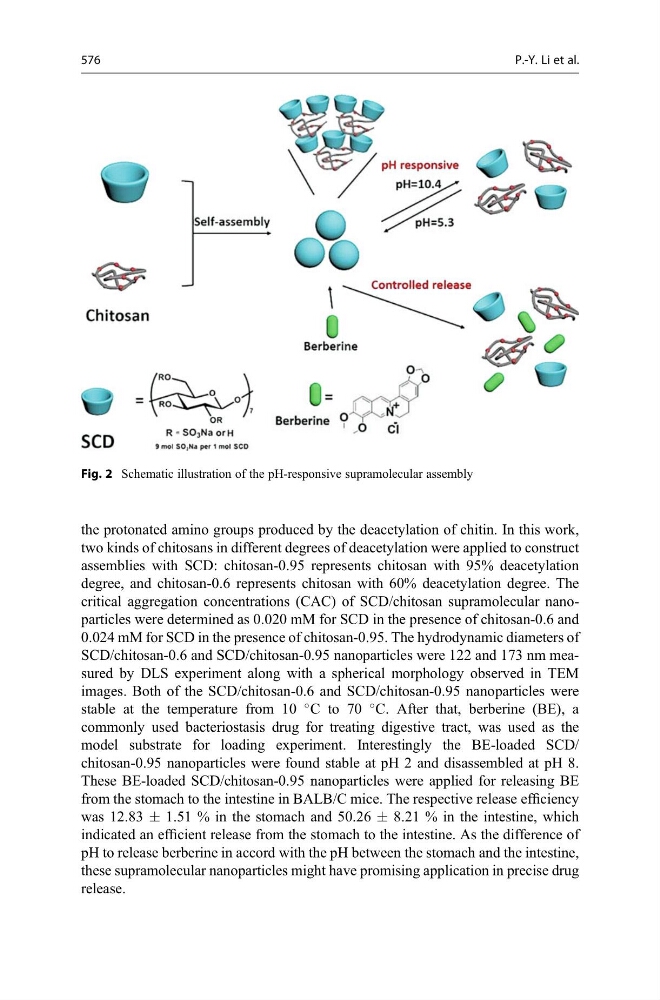
the protonated amino groups produced by the deacetylation of chitin. In this work,
two kinds of chitosans in different degrees of deacetylation were applied to construct
assemblies with SCD: chitosan-0.95 represents chitosan with 95% deacetylation
degree, and chitosan-0.6 represents chitosan with 60% deacetylation degree. The
critical aggregation concentrations (CAC) of SCD/chitosan supramolecular nanoparticles were determined as 0.020 mM for SCD in the presence of chitosan-0.6 and
0.024 mM for SCD in the presence of chitosan-0.95. The hydrodynamic diameters of
SCD/chitosan-0.6 and SCD/chitosan-0.95 nanoparticles were 122 and 173 nm measured by DLS experiment along with a spherical morphology observed in TEM
images. Both of the SCD/chitosan-0.6 and SCD/chitosan-0.95 nanoparticles were
stable at the temperature from 10
C to 70
C. After that, berberine (BE), a
commonly used bacteriostasis drug for treating digestive tract, was used as the
model substrate for loading experiment. Interestingly the BE-loaded SCD/
chitosan-0.95 nanoparticles were found stable at pH 2 and disassembled at pH 8.
These BE-loaded SCD/chitosan-0.95 nanoparticles were applied for releasing BE
from the stomach to the intestine in BALB/C mice. The respective release efficiency
was 12.83 Æ 1.51 % in the stomach and 50.26 Æ 8.21 % in the intestine, which
indicated an efficient release from the stomach to the intestine. As the difference of
pH to release berberine in accord with the pH between the stomach and the intestine,
these supramolecular nanoparticles might have promising application in precise drug
release.
Fig. 2 Schematic illustration of the pH-responsive supramolecular assembly
576
P.-Y. Li et al.