

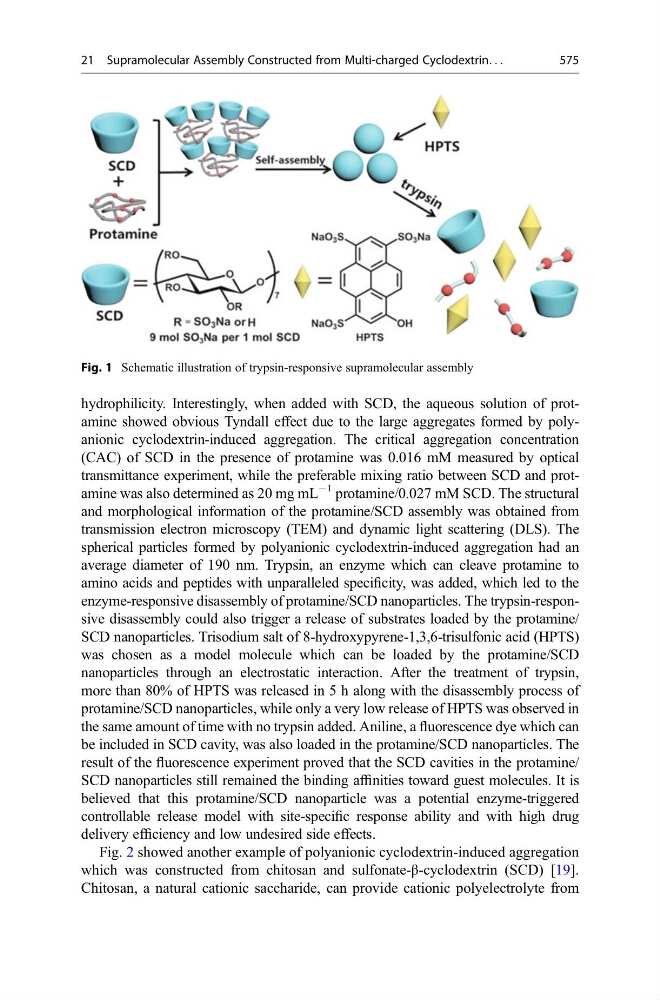
hydrophilicity. Interestingly, when added with SCD, the aqueous solution of protamine showed obvious Tyndall effect due to the large aggregates formed by polyanionic cyclodextrin-induced aggregation. The critical aggregation concentration
(CAC) of SCD in the presence of protamine was 0.016 mM measured by optical
transmittance experiment, while the preferable mixing ratio between SCD and protamine was also determined as 20 mg mL
À1 protamine/0.027 mM SCD. The structural
and morphological information of the protamine/SCD assembly was obtained from
transmission electron microscopy (TEM) and dynamic light scattering (DLS). The
spherical particles formed by polyanionic cyclodextrin-induced aggregation had an
average diameter of 190 nm. Trypsin, an enzyme which can cleave protamine to
amino acids and peptides with unparalleled specificity, was added, which led to the
enzyme-responsive disassembly of protamine/SCD nanoparticles. The trypsin-responsive disassembly could also trigger a release of substrates loaded by the protamine/
SCD nanoparticles. Trisodium salt of 8-hydroxypyrene-1,3,6-trisulfonic acid (HPTS)
was chosen as a model molecule which can be loaded by the protamine/SCD
nanoparticles through an electrostatic interaction. After the treatment of trypsin,
more than 80% of HPTS was released in 5 h along with the disassembly process of
protamine/SCD nanoparticles, while only a very low release of HPTS was observed in
the same amount of time with no trypsin added. Aniline, a fluorescence dye which can
be included in SCD cavity, was also loaded in the protamine/SCD nanoparticles. The
result of the fluorescence experiment proved that the SCD cavities in the protamine/
SCD nanoparticles still remained the binding affinities toward guest molecules. It is
believed that this protamine/SCD nanoparticle was a potential enzyme-triggered
controllable release model with site-specific response ability and with high drug
delivery efficiency and low undesired side effects.
Fig. 2 showed another example of polyanionic cyclodextrin-induced aggregation
which was constructed from chitosan and sulfonate-β-cyclodextrin (SCD) [19].
Chitosan, a natural cationic saccharide, can provide cationic polyelectrolyte from
Fig. 1 Schematic illustration of trypsin-responsive supramolecular assembly
21 Supramolecular Assembly Constructed from Multi-charged Cyclodextrin. . .
575