

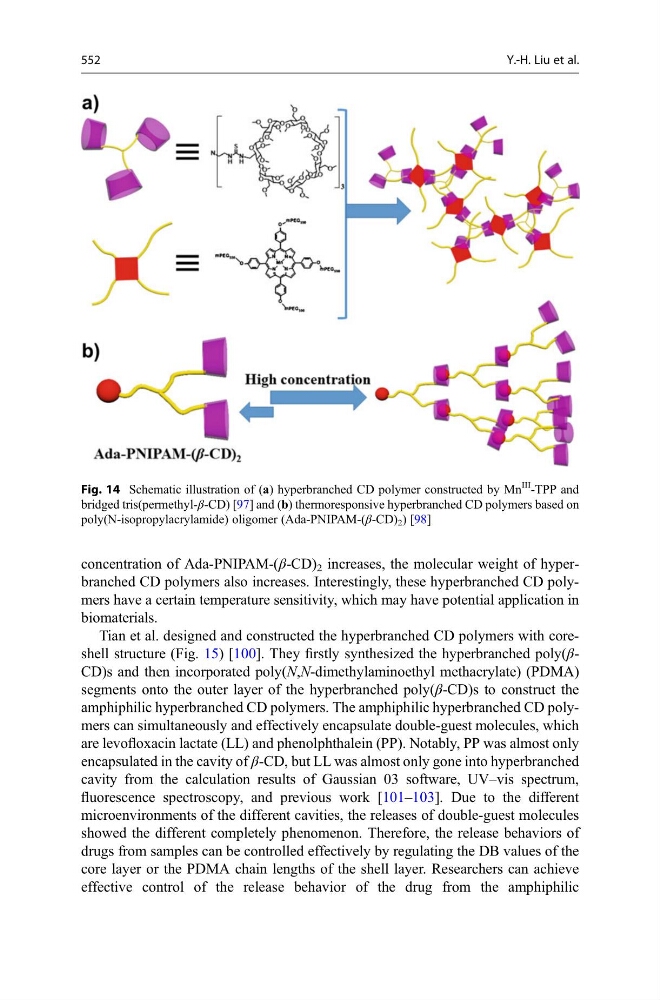
concentration of Ada-PNIPAM-(β-CD) 2 increases, the molecular weight of hyperbranched CD polymers also increases. Interestingly, these hyperbranched CD polymers have a certain temperature sensitivity, which may have potential application in
biomaterials.
Tian et al. designed and constructed the hyperbranched CD polymers with coreshell structure (Fig. 15) [100]. They firstly synthesized the hyperbranched poly(βCD)s and then incorporated poly(N,N-dimethylaminoethyl methacrylate) (PDMA)
segments onto the outer layer of the hyperbranched poly(β-CD)s to construct the
amphiphilic hyperbranched CD polymers. The amphiphilic hyperbranched CD polymers can simultaneously and effectively encapsulate double-guest molecules, which
are levofloxacin lactate (LL) and phenolphthalein (PP). Notably, PP was almost only
encapsulated in the cavity of β-CD, but LL was almost only gone into hyperbranched
cavity from the calculation results of Gaussian 03 software, UV–vis spectrum,
fluorescence spectroscopy, and previous work [101–103]. Due to the different
microenvironments of the different cavities, the releases of double-guest molecules
showed the different completely phenomenon. Therefore, the release behaviors of
drugs from samples can be controlled effectively by regulating the DB values of the
core layer or the PDMA chain lengths of the shell layer. Researchers can achieve
effective control of the release behavior of the drug from the amphiphilic
Fig. 14 Schematic illustration of (a) hyperbranched CD polymer constructed by Mn
III
-TPP and
bridged tris(permethyl-β-CD) [97] and (b) thermoresponsive hyperbranched CD polymers based on
poly(N-isopropylacrylamide) oligomer (Ada-PNIPAM-(β-CD) 2 ) [98]
552
Y.-H. Liu et al.