

hyperbranched α-CD polymers with different hyperbranched polyamidoamine
dendrimers to research the effect of different dendrimers in hyperbranched α-CD
polymers on gene transfection [91]. To investigate the effect of the content of α-CDs
in hyperbranched α-CD polymers on gene transfection efficiency, they prepared the
hyperbranched α-CD polymers with different average degrees of substitution of αCDs [92]. Besides, they not only evaluated the potential application of the hyperbranched α-CD polymers as a small interfering RNA (siRNA) carrier [93] but also
researched the transfer activity of hyperbranched α-CD polymers as short hairpin
RNA (shRNA) carrier which expresses pDNA [95].
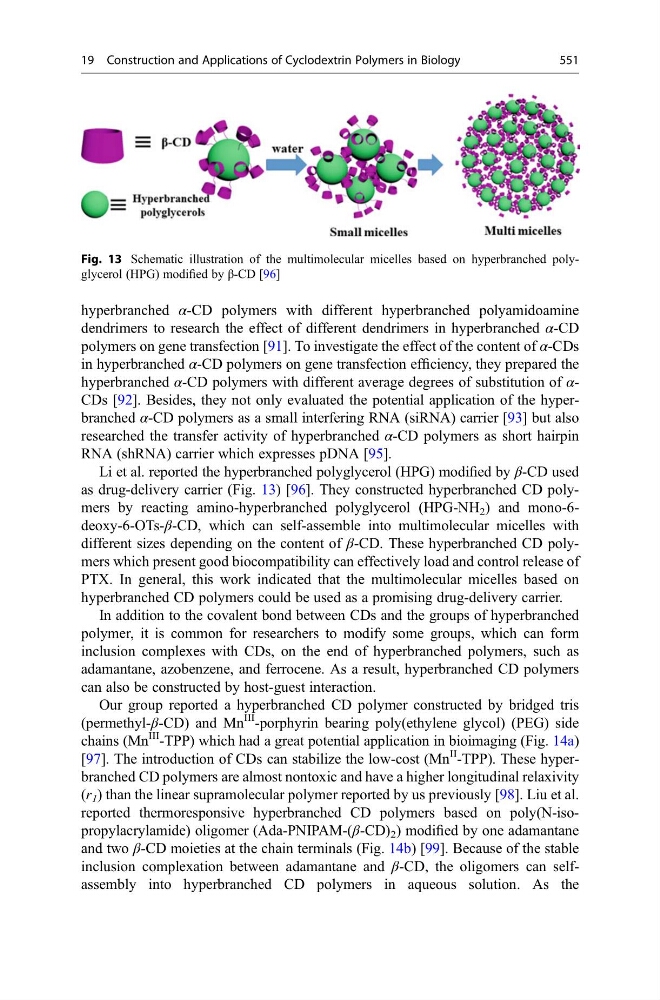
Li et al. reported the hyperbranched polyglycerol (HPG) modified by β-CD used
as drug-delivery carrier (Fig. 13) [96]. They constructed hyperbranched CD polymers by reacting amino-hyperbranched polyglycerol (HPG-NH 2 ) and mono-6deoxy-6-OTs-β-CD, which can self-assemble into multimolecular micelles with
different sizes depending on the content of β-CD. These hyperbranched CD polymers which present good biocompatibility can effectively load and control release of
PTX. In general, this work indicated that the multimolecular micelles based on
hyperbranched CD polymers could be used as a promising drug-delivery carrier.
In addition to the covalent bond between CDs and the groups of hyperbranched
polymer, it is common for researchers to modify some groups, which can form
inclusion complexes with CDs, on the end of hyperbranched polymers, such as
adamantane, azobenzene, and ferrocene. As a result, hyperbranched CD polymers
can also be constructed by host-guest interaction.
Our group reported a hyperbranched CD polymer constructed by bridged tris
(permethyl-β-CD) and Mn
III -porphyrin bearing poly(ethylene glycol) (PEG) side
chains (Mn
III -TPP) which had a great potential application in bioimaging (Fig. 14a)
[97]. The introduction of CDs can stabilize the low-cost (Mn
II -TPP). These hyperbranched CD polymers are almost nontoxic and have a higher longitudinal relaxivity
(r 1 ) than the linear supramolecular polymer reported by us previously [98]. Liu et al.
reported thermoresponsive hyperbranched CD polymers based on poly(N-isopropylacrylamide) oligomer (Ada-PNIPAM-(β-CD) 2 ) modified by one adamantane
and two β-CD moieties at the chain terminals (Fig. 14b) [99]. Because of the stable
inclusion complexation between adamantane and β-CD, the oligomers can selfassembly into hyperbranched CD polymers in aqueous solution. As the
Fig. 13 Schematic illustration of the multimolecular micelles based on hyperbranched polyglycerol (HPG) modified by β-CD [96]
19 Construction and Applications of Cyclodextrin Polymers in Biology
551