

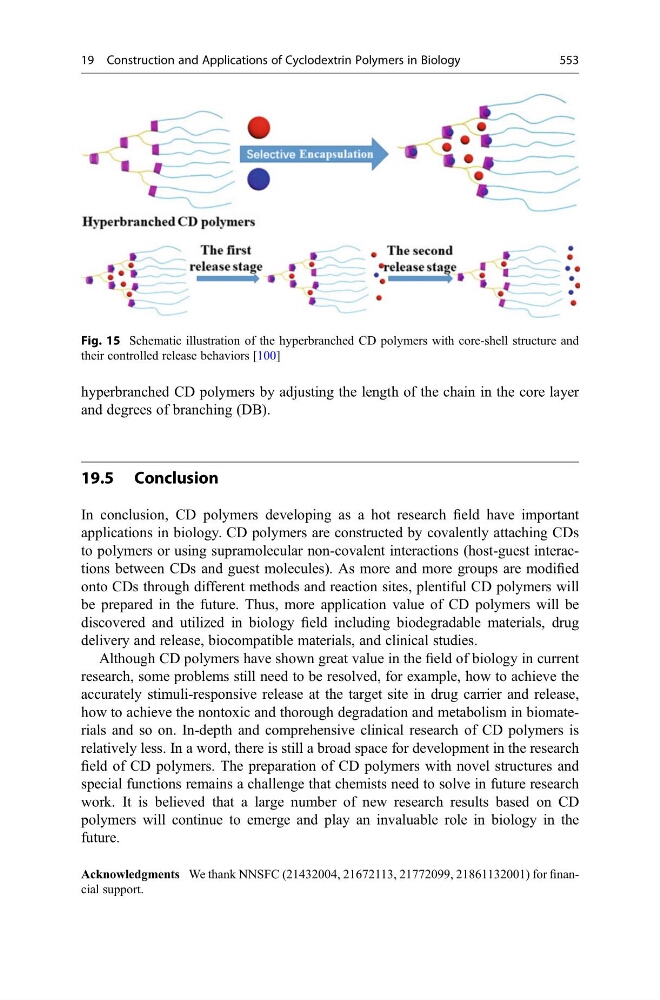
hyperbranched CD polymers by adjusting the length of the chain in the core layer
and degrees of branching (DB).
19.5 Conclusion
In conclusion, CD polymers developing as a hot research field have important
applications in biology. CD polymers are constructed by covalently attaching CDs
to polymers or using supramolecular non-covalent interactions (host-guest interactions between CDs and guest molecules). As more and more groups are modified
onto CDs through different methods and reaction sites, plentiful CD polymers will
be prepared in the future. Thus, more application value of CD polymers will be
discovered and utilized in biology field including biodegradable materials, drug
delivery and release, biocompatible materials, and clinical studies.
Although CD polymers have shown great value in the field of biology in current
research, some problems still need to be resolved, for example, how to achieve the
accurately stimuli-responsive release at the target site in drug carrier and release,
how to achieve the nontoxic and thorough degradation and metabolism in biomaterials and so on. In-depth and comprehensive clinical research of CD polymers is
relatively less. In a word, there is still a broad space for development in the research
field of CD polymers. The preparation of CD polymers with novel structures and
special functions remains a challenge that chemists need to solve in future research
work. It is believed that a large number of new research results based on CD
polymers will continue to emerge and play an invaluable role in biology in the
future.
Acknowledgments We thank NNSFC (21432004, 21672113, 21772099, 21861132001) for financial support.
Fig. 15 Schematic illustration of the hyperbranched CD polymers with core-shell structure and
their controlled release behaviors [100]
19 Construction and Applications of Cyclodextrin Polymers in Biology
553