

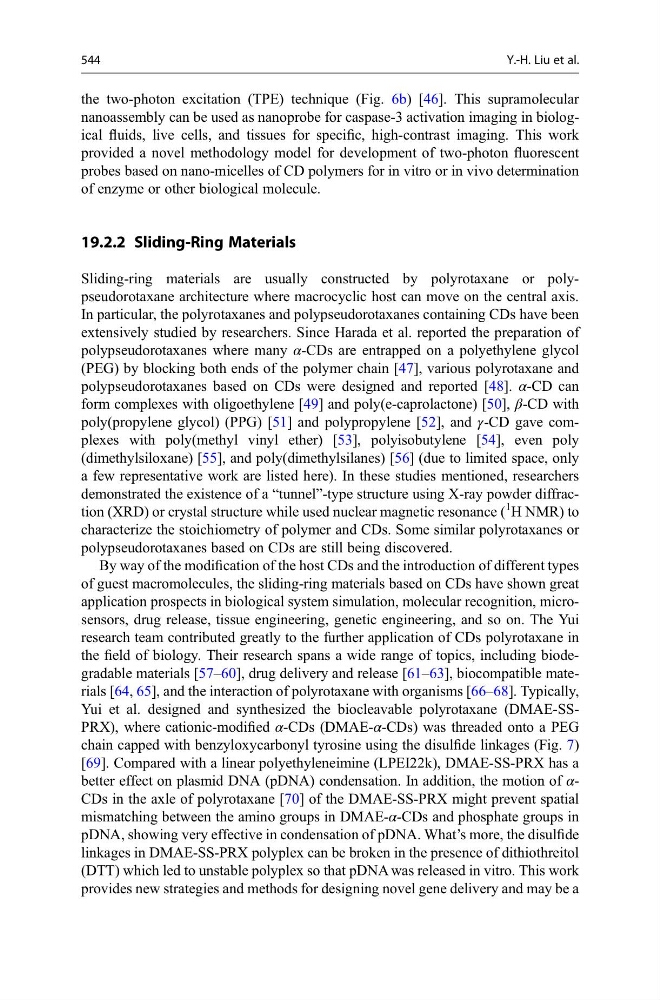
the two-photon excitation (TPE) technique (Fig. 6b) [46]. This supramolecular
nanoassembly can be used as nanoprobe for caspase-3 activation imaging in biological fluids, live cells, and tissues for specific, high-contrast imaging. This work
provided a novel methodology model for development of two-photon fluorescent
probes based on nano-micelles of CD polymers for in vitro or in vivo determination
of enzyme or other biological molecule.
19.2.2 Sliding-Ring Materials
Sliding-ring materials are usually constructed by polyrotaxane or polypseudorotaxane architecture where macrocyclic host can move on the central axis.
In particular, the polyrotaxanes and polypseudorotaxanes containing CDs have been
extensively studied by researchers. Since Harada et al. reported the preparation of
polypseudorotaxanes where many α-CDs are entrapped on a polyethylene glycol
(PEG) by blocking both ends of the polymer chain [47], various polyrotaxane and
polypseudorotaxanes based on CDs were designed and reported [48]. α-CD can
form complexes with oligoethylene [49] and poly(e-caprolactone) [50], β-CD with
poly(propylene glycol) (PPG) [51] and polypropylene [52], and γ-CD gave complexes with poly(methyl vinyl ether) [53], polyisobutylene [54], even poly
(dimethylsiloxane) [55], and poly(dimethylsilanes) [56] (due to limited space, only
a few representative work are listed here). In these studies mentioned, researchers
demonstrated the existence of a “tunnel”-type structure using X-ray powder diffraction (XRD) or crystal structure while used nuclear magnetic resonance (
1
H NMR) to
characterize the stoichiometry of polymer and CDs. Some similar polyrotaxanes or
polypseudorotaxanes based on CDs are still being discovered.
By way of the modification of the host CDs and the introduction of different types
of guest macromolecules, the sliding-ring materials based on CDs have shown great
application prospects in biological system simulation, molecular recognition, microsensors, drug release, tissue engineering, genetic engineering, and so on. The Yui
research team contributed greatly to the further application of CDs polyrotaxane in
the field of biology. Their research spans a wide range of topics, including biodegradable materials [57–60], drug delivery and release [61–63], biocompatible materials [64, 65], and the interaction of polyrotaxane with organisms [66–68]. Typically,
Yui et al. designed and synthesized the biocleavable polyrotaxane (DMAE-SSPRX), where cationic-modified α-CDs (DMAE-α-CDs) was threaded onto a PEG
chain capped with benzyloxycarbonyl tyrosine using the disulfide linkages (Fig. 7)
[69]. Compared with a linear polyethyleneimine (LPEI22k), DMAE-SS-PRX has a
better effect on plasmid DNA (pDNA) condensation. In addition, the motion of αCDs in the axle of polyrotaxane [70] of the DMAE-SS-PRX might prevent spatial
mismatching between the amino groups in DMAE-α-CDs and phosphate groups in
pDNA, showing very effective in condensation of pDNA. What’s more, the disulfide
linkages in DMAE-SS-PRX polyplex can be broken in the presence of dithiothreitol
(DTT) which led to unstable polyplex so that pDNA was released in vitro. This work
provides new strategies and methods for designing novel gene delivery and may be a
544
Y.-H. Liu et al.