

69% ee in water and in 81% yield and 90% ee in methanol both at 0
C. By adding
γ-CD or CB[8] to the aqueous solution, the chemical and optical yields of 20 derived
from 48 are further augmented to 97–98% yield and 98–99% ee in 14% aqueous
LiCl solution at À18
C, achieving an ultimate stereocontrol for the first time in a
supramolecular photochirogenesis [45].
18.3.6 Miscellaneous Bimolecular Chiral Photoreactions Mediated
by CD
Although AC is certainly the most frequently employed guest substrate in the
majority of CD-mediated bimolecular chiral photoreactions, a couple of other
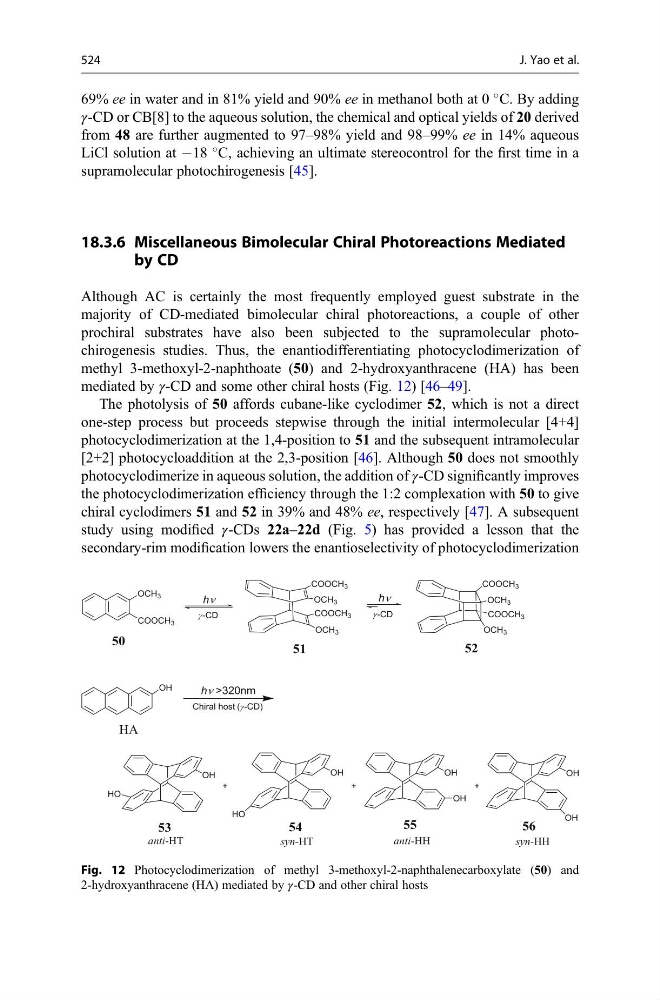
prochiral substrates have also been subjected to the supramolecular photochirogenesis studies. Thus, the enantiodifferentiating photocyclodimerization of
methyl 3-methoxyl-2-naphthoate (50) and 2-hydroxyanthracene (HA) has been
mediated by γ-CD and some other chiral hosts (Fig. 12) [46–49].
The photolysis of 50 affords cubane-like cyclodimer 52, which is not a direct
one-step process but proceeds stepwise through the initial intermolecular [4+4]
photocyclodimerization at the 1,4-position to 51 and the subsequent intramolecular
[2+2] photocycloaddition at the 2,3-position [46]. Although 50 does not smoothly
photocyclodimerize in aqueous solution, the addition of γ-CD significantly improves
the photocyclodimerization efficiency through the 1:2 complexation with 50 to give
chiral cyclodimers 51 and 52 in 39% and 48% ee, respectively [47]. A subsequent
study using modified γ-CDs 22a–22d (Fig. 5) has provided a lesson that the
secondary-rim modification lowers the enantioselectivity of photocyclodimerization
Fig. 12 Photocyclodimerization of methyl 3-methoxyl-2-naphthalenecarboxylate (50) and
2-hydroxyanthracene (HA) mediated by γ-CD and other chiral hosts
524
J. Yao et al.