

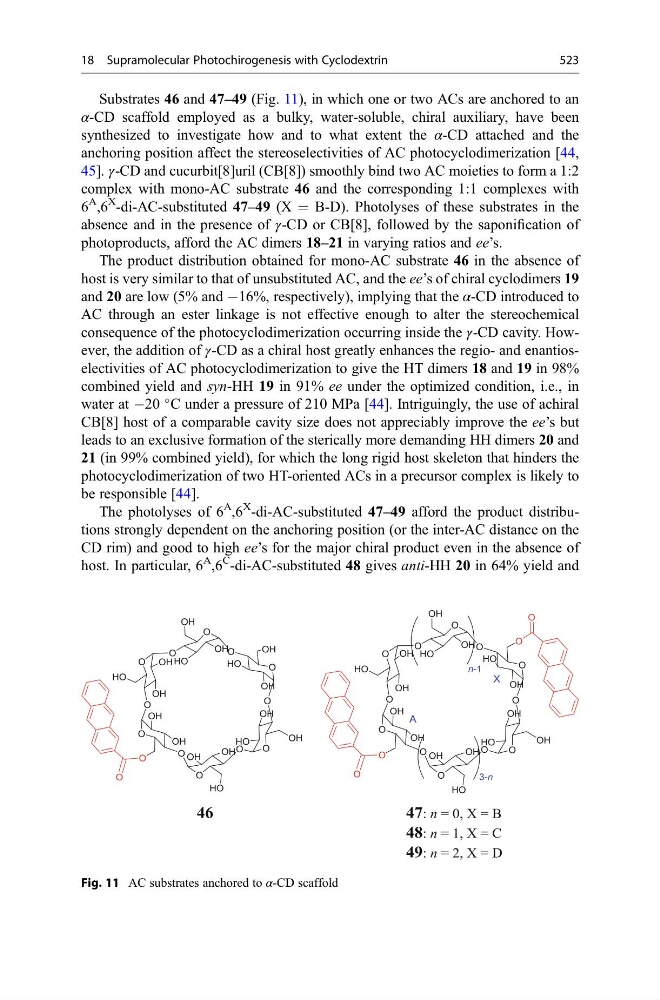
Substrates 46 and 47–49 (Fig. 11), in which one or two ACs are anchored to an
α-CD scaffold employed as a bulky, water-soluble, chiral auxiliary, have been
synthesized to investigate how and to what extent the α-CD attached and the
anchoring position affect the stereoselectivities of AC photocyclodimerization [44,
45]. γ-CD and cucurbit[8]uril (CB[8]) smoothly bind two AC moieties to form a 1:2
complex with mono-AC substrate 46 and the corresponding 1:1 complexes with
6
A ,6
X -di-AC-substituted 47–49 (X = B-D). Photolyses of these substrates in the
absence and in the presence of γ-CD or CB[8], followed by the saponification of
photoproducts, afford the AC dimers 18–21 in varying ratios and ee’s.
The product distribution obtained for mono-AC substrate 46 in the absence of
host is very similar to that of unsubstituted AC, and the ee’s of chiral cyclodimers 19
and 20 are low (5% and À16%, respectively), implying that the α-CD introduced to
AC through an ester linkage is not effective enough to alter the stereochemical
consequence of the photocyclodimerization occurring inside the γ-CD cavity. However, the addition of γ-CD as a chiral host greatly enhances the regio- and enantioselectivities of AC photocyclodimerization to give the HT dimers 18 and 19 in 98%
combined yield and syn-HH 19 in 91% ee under the optimized condition, i.e., in
water at À20
C under a pressure of 210 MPa [44]. Intriguingly, the use of achiral
CB[8] host of a comparable cavity size does not appreciably improve the ee’s but
leads to an exclusive formation of the sterically more demanding HH dimers 20 and
21 (in 99% combined yield), for which the long rigid host skeleton that hinders the
photocyclodimerization of two HT-oriented ACs in a precursor complex is likely to
be responsible [44].
The photolyses of 6
A ,6
X -di-AC-substituted 47–49 afford the product distributions strongly dependent on the anchoring position (or the inter-AC distance on the
CD rim) and good to high ee’s for the major chiral product even in the absence of
host. In particular, 6
A ,6
C -di-AC-substituted 48 gives anti-HH 20 in 64% yield and
Fig. 11 AC substrates anchored to α-CD scaffold
18 Supramolecular Photochirogenesis with Cyclodextrin
523