

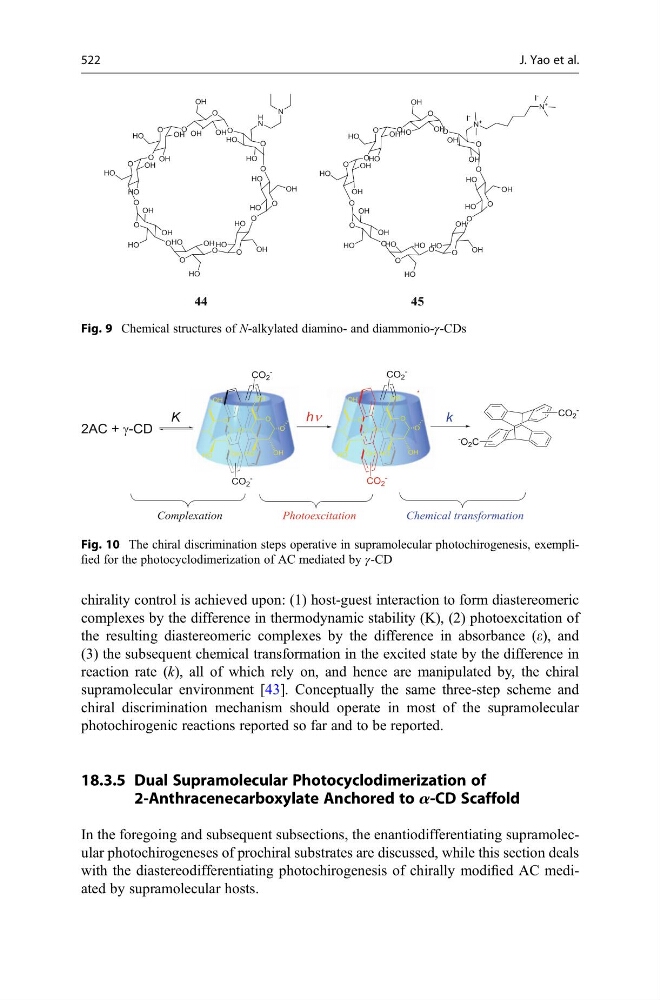
chirality control is achieved upon: (1) host-guest interaction to form diastereomeric
complexes by the difference in thermodynamic stability (K), (2) photoexcitation of
the resulting diastereomeric complexes by the difference in absorbance (e), and
(3) the subsequent chemical transformation in the excited state by the difference in
reaction rate (k), all of which rely on, and hence are manipulated by, the chiral
supramolecular environment [43]. Conceptually the same three-step scheme and
chiral discrimination mechanism should operate in most of the supramolecular
photochirogenic reactions reported so far and to be reported.
18.3.5 Dual Supramolecular Photocyclodimerization of
2-Anthracenecarboxylate Anchored to a-CD Scaffold
In the foregoing and subsequent subsections, the enantiodifferentiating supramolecular photochirogeneses of prochiral substrates are discussed, while this section deals
with the diastereodifferentiating photochirogenesis of chirally modified AC mediated by supramolecular hosts.
Fig. 9 Chemical structures of N-alkylated diamino- and diammonio-γ-CDs
Fig. 10 The chiral discrimination steps operative in supramolecular photochirogenesis, exemplified for the photocyclodimerization of AC mediated by γ-CD
522
J. Yao et al.