

of 50 probably due to the interrupted hydrogen-bonding network that leads to a
flexible CD skeleton [47].
The γ-CD-mediated photocyclodimerization of 2-hydroxyanthracene (HA) to
cyclodimers 53–56 has been performed in aqueous solutions and in the solid state
[49]. In contrast to AC (vide supra), anionic HA forms a fairly stable 1:1 complex
with γ-CD (K 1 = 4100 M
À1 ) but essentially no 1:2 complex in a basic solution at
pH 10.5. This contrasting behavior of HA against AC has been ascribed to the
negative charge delocalized over the entire HA molecule, which leads to the
electrostatic repulsion when two anionic HAs are accommodated in a CD cavity
[49]. On the other hand, neutral HA forms a stable 1:2 complex with γ-CD.
Photolysis of HA in aqueous solution (pH 7) containing γ-CD yields syn-HT 54 in
12–14% ee and anti-HH 55 in 5–6% ee. Photoirradiation of a solid-state complex
prepared by grinding HA with 0.5 equivalent of γ-CD affords 54 of À17% ee in 11%
yield and racemic 55 in 48% yield [49].
18.4 Catalytic Supramolecular Photochirogenesis
with Sensitizing CD Hosts
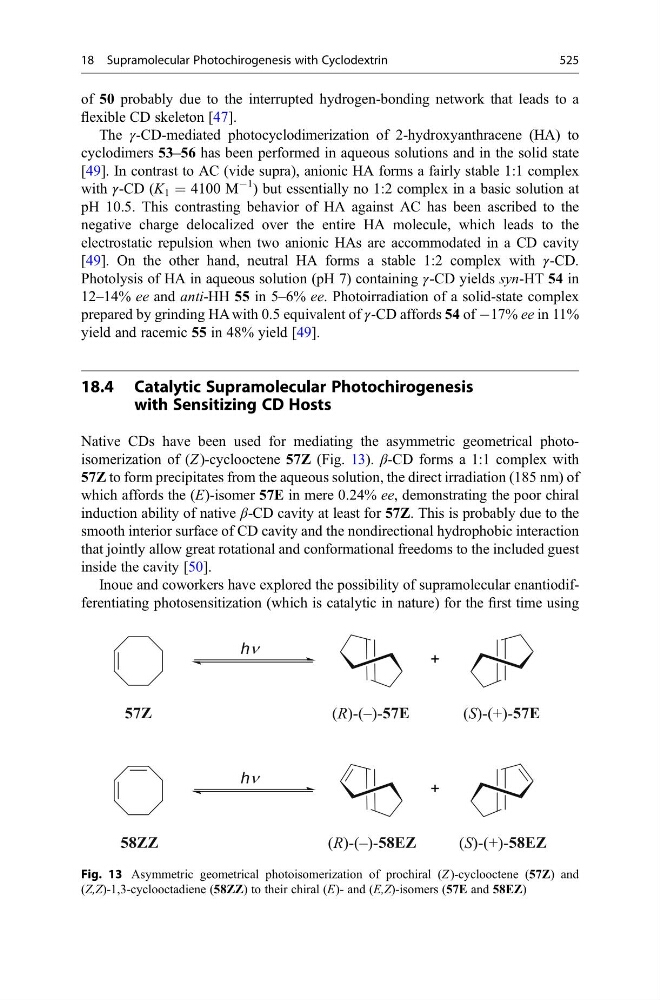
Native CDs have been used for mediating the asymmetric geometrical photoisomerization of (Z )-cyclooctene 57Z (Fig. 13). β-CD forms a 1:1 complex with
57Z to form precipitates from the aqueous solution, the direct irradiation (185 nm) of
which affords the (E)-isomer 57E in mere 0.24% ee, demonstrating the poor chiral
induction ability of native β-CD cavity at least for 57Z. This is probably due to the
smooth interior surface of CD cavity and the nondirectional hydrophobic interaction
that jointly allow great rotational and conformational freedoms to the included guest
inside the cavity [50].
Inoue and coworkers have explored the possibility of supramolecular enantiodifferentiating photosensitization (which is catalytic in nature) for the first time using
Fig. 13 Asymmetric geometrical photoisomerization of prochiral (Z )-cyclooctene (57Z) and
(Z,Z)-1,3-cyclooctadiene (58ZZ) to their chiral (E)- and (E,Z)-isomers (57E and 58EZ)
18 Supramolecular Photochirogenesis with Cyclodextrin
525