

photocyclodimerization of AC, Tamaki et al. have examined all of the commercially
available CDs, including β-CD, as chiral hosts to find that AC forms a 2:2 complex
with β-CD and affords achiral anti-HT dimer 18 as the major product [27, 29]. Very
recently, Yang and coworkers have reinvestigated the complexation and photocyclodimerization behaviors of AC with native and modified β-CDs in considerable
detail to unveil a rather unexpected picture of this supramolecular photochirogenic
system (Fig. 7) [27]. They have shown that AC forms the regular 1:1 complex with
β-CD with an association constant (K 1 ) of 3800 M
À1 , the subsequent dimerization of
which leads to the formation of 2:2 complex with K 2 = 150 M
À1 . By decreasing
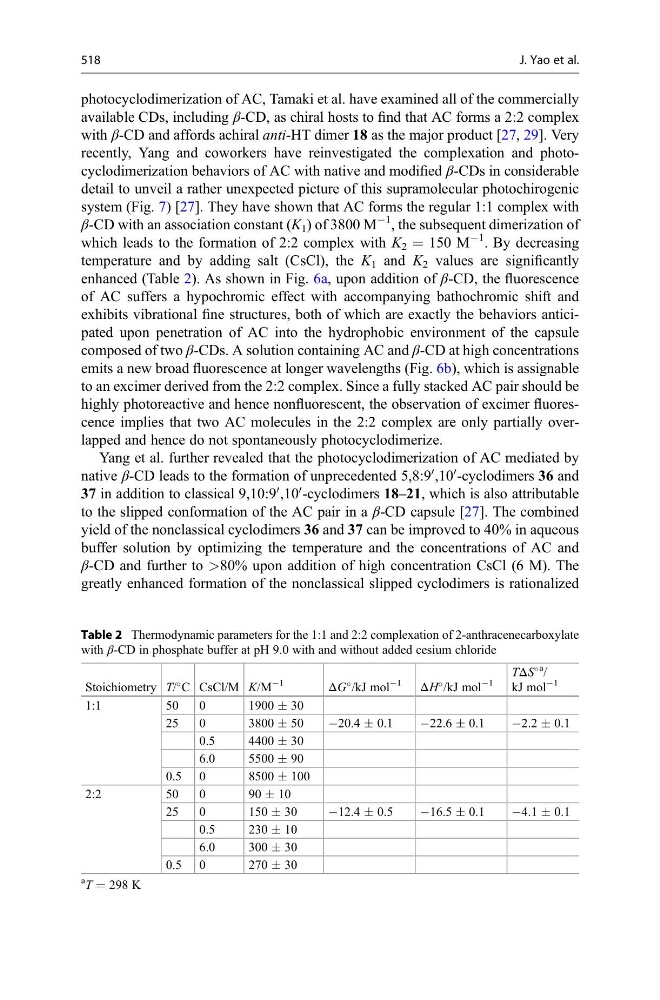
temperature and by adding salt (CsCl), the K 1 and K 2 values are significantly
enhanced (Table 2). As shown in Fig. 6a, upon addition of β-CD, the fluorescence
of AC suffers a hypochromic effect with accompanying bathochromic shift and
exhibits vibrational fine structures, both of which are exactly the behaviors anticipated upon penetration of AC into the hydrophobic environment of the capsule
composed of two β-CDs. A solution containing AC and β-CD at high concentrations
emits a new broad fluorescence at longer wavelengths (Fig. 6b), which is assignable
to an excimer derived from the 2:2 complex. Since a fully stacked AC pair should be
highly photoreactive and hence nonfluorescent, the observation of excimer fluorescence implies that two AC molecules in the 2:2 complex are only partially overlapped and hence do not spontaneously photocyclodimerize.
Yang et al. further revealed that the photocyclodimerization of AC mediated by
native β-CD leads to the formation of unprecedented 5,8:9
0 ,10
0 -cyclodimers 36 and
37 in addition to classical 9,10:9
0 ,10
0 -cyclodimers 18–21, which is also attributable
to the slipped conformation of the AC pair in a β-CD capsule [27]. The combined
yield of the nonclassical cyclodimers 36 and 37 can be improved to 40% in aqueous
buffer solution by optimizing the temperature and the concentrations of AC and
β-CD and further to >80% upon addition of high concentration CsCl (6 M). The
greatly enhanced formation of the nonclassical slipped cyclodimers is rationalized
Table 2 Thermodynamic parameters for the 1:1 and 2:2 complexation of 2-anthracenecarboxylate
with β-CD in phosphate buffer at pH 9.0 with and without added cesium chloride
Stoichiometry T/
C CsCl/M K/M
À1
ΔG
/kJ mol
À1
ΔH
/kJ mol
À1
TΔS
a /
kJ mol
À1
1:1
50
0
1900 Æ 30
25
0
3800 Æ 50
À20.4 Æ 0.1
À22.6 Æ 0.1
À2.2 Æ 0.1
0.5
4400 Æ 30
6.0
5500 Æ 90
0.5 0
8500 Æ 100
2:2
50
0
90 Æ 10
25
0
150 Æ 30
À12.4 Æ 0.5
À16.5 Æ 0.1
À4.1 Æ 0.1
0.5
230 Æ 10
6.0
300 Æ 30
0.5 0
270 Æ 30
a T = 298 K
518
J. Yao et al.