

by the ion-pairing interaction of Cs
+ with anionic ACs residing in a β-CD capsule to
facilitate the sled conformation of the AC pair in the 2:2 complex and the subsequent
formation of the slipped cyclodimers upon irradiation. Encouraged by this result,
they designed and synthesized a series of mono- and dicationic β-CD derivatives
38–43 to achieve the exclusive formation of irregular dimers 36 and 37 in 71% and
À45% ee, respectively, by optimizing the environmental parameters.
As a representative supramolecular photochirogenic reaction, the complexation
and photocyclodimerization mechanisms that enable the exceptional stereochemical and photochemical outcomes have been elucidated in considerable details
[27]. As illustrated in Fig. 8 (left), when two prochiral ACs are accommodated
in a capsule composed of inherently chiral β-CDs in a HT manner (essentially no
HH cyclodimers obtained experimentally), there exist three configurational possibilities with respect to the re- and si-enantiotopic faces of AC that confront in the
resulting 2:2 complex, which lead to the formation of diastereomeric re-re, re-si/sire, and si-si complexes precursor to the HT cyclodimers 18, 19, 36, and 37. The resi and si-re complexes are equivalent to each other in the ground state, but
photoexcitation of the re- or si-AC in a si-re (or re-si) complex breaks the
centrosymmetric nature of the two facing ACs to render the reÃ-si and re-siÃ
complexes a pair of diastereomers, while the re-re and si-si complexes are inherently diastereomeric to each other in the ground and excited states. Since the AC
pair in a 2:2 complex is unable to exchange the position or orientation within the
short lifetime of excited-state AC, the stereochemical outcomes (regio- and
enantioselectivity) are determined basically by the ground-state thermodynamics
and the excited-state kinetics but are still manipulable by various internal and
external factors, such as host modification, excitation wavelength (vide infra),
temperature, pressure, solvent, and added salt.
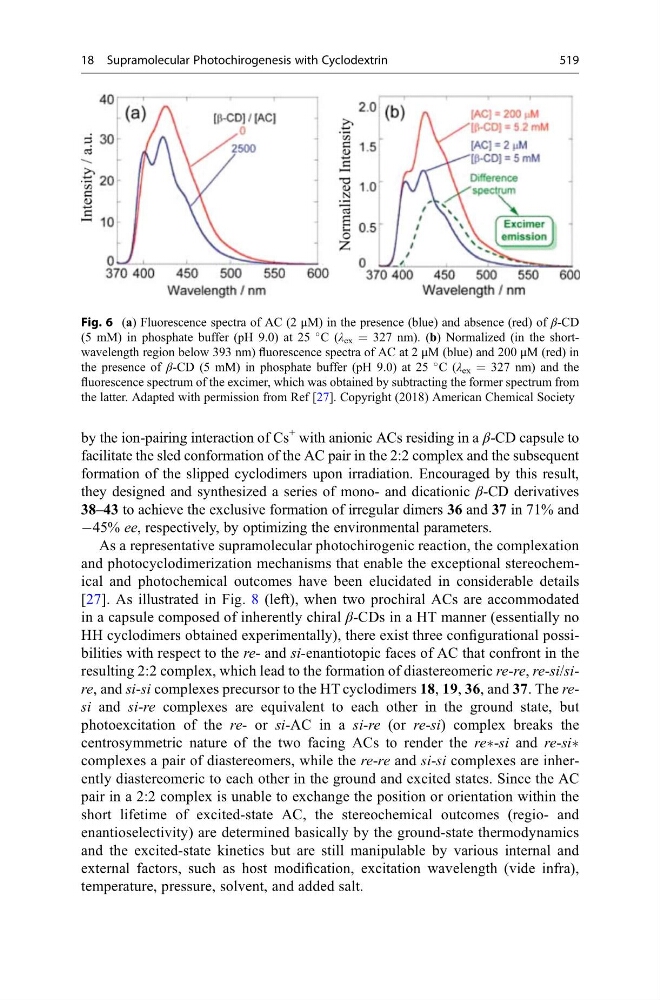
Fig. 6 (a) Fluorescence spectra of AC (2 μM) in the presence (blue) and absence (red) of β-CD
(5 mM) in phosphate buffer (pH 9.0) at 25
C (λ ex = 327 nm). (b) Normalized (in the shortwavelength region below 393 nm) fluorescence spectra of AC at 2 μM (blue) and 200 μM (red) in
the presence of β-CD (5 mM) in phosphate buffer (pH 9.0) at 25
C (λ ex = 327 nm) and the
fluorescence spectrum of the excimer, which was obtained by subtracting the former spectrum from
the latter. Adapted with permission from Ref [27]. Copyright (2018) American Chemical Society
18 Supramolecular Photochirogenesis with Cyclodextrin
519