

33a-d (X = E, D, C, and B) are critical functions of the inter-amino distance on the
primary rim of γ-CD. In particular, the relative yield of anti-HH 20 versus syn-HH
21 significantly increases with increasing inter-amino distance with accompanying
switching of the 20/21 ratio [33]. The photocyclodimerization of AC with
dipyridinio-γ-CDs 34c and 34b affords anti-HH 20 in 32% and 23% ee, respectively, under the optimized temperature and solvent conditions.
To better control the complexation and photocyclodimerization performances of
AC, 6
A
,6
X -diguanidino-γ-CDs 35a-d have been synthesized as chiral dicationic
hosts for mediating the AC photocyclodimerization. The guanidium substituents
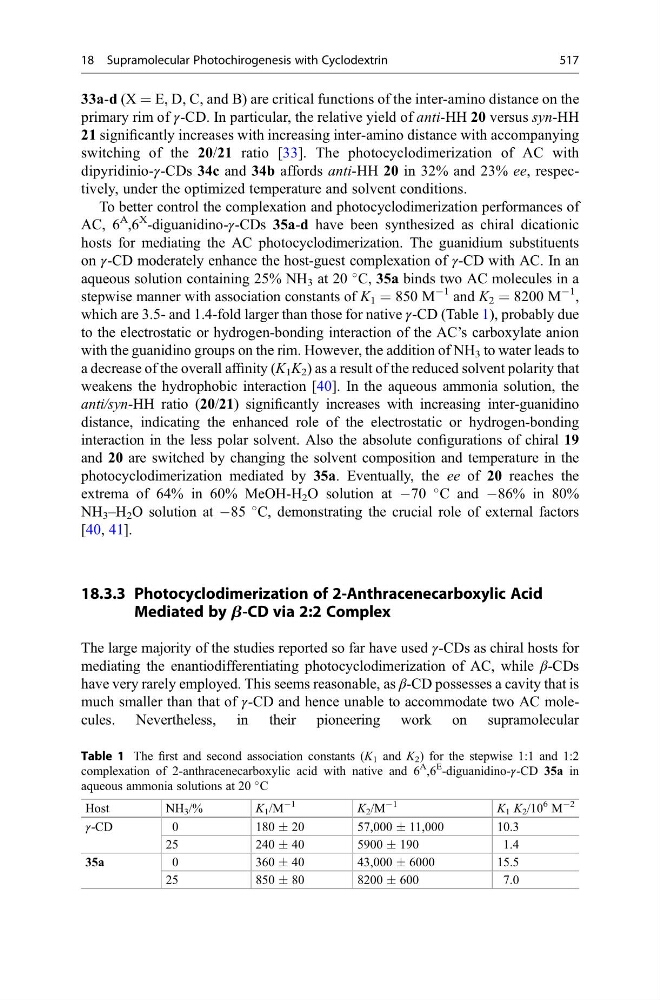
on γ-CD moderately enhance the host-guest complexation of γ-CD with AC. In an
aqueous solution containing 25% NH 3 at 20
C, 35a binds two AC molecules in a
stepwise manner with association constants of K 1 = 850 M
À1 and K 2 = 8200 M
À1 ,
which are 3.5- and 1.4-fold larger than those for native γ-CD (Table 1), probably due
to the electrostatic or hydrogen-bonding interaction of the AC’s carboxylate anion
with the guanidino groups on the rim. However, the addition of NH 3 to water leads to
a decrease of the overall affinity (K 1 K 2 ) as a result of the reduced solvent polarity that
weakens the hydrophobic interaction [40]. In the aqueous ammonia solution, the
anti/syn-HH ratio (20/21) significantly increases with increasing inter-guanidino
distance, indicating the enhanced role of the electrostatic or hydrogen-bonding
interaction in the less polar solvent. Also the absolute configurations of chiral 19
and 20 are switched by changing the solvent composition and temperature in the
photocyclodimerization mediated by 35a. Eventually, the ee of 20 reaches the
extrema of 64% in 60% MeOH-H 2 O solution at À70
C and À86% in 80%
NH 3 –H 2 O solution at À85
C, demonstrating the crucial role of external factors
[40, 41].
18.3.3 Photocyclodimerization of 2-Anthracenecarboxylic Acid
Mediated by b-CD via 2:2 Complex
The large majority of the studies reported so far have used γ-CDs as chiral hosts for
mediating the enantiodifferentiating photocyclodimerization of AC, while β-CDs
have very rarely employed. This seems reasonable, as β-CD possesses a cavity that is
much smaller than that of γ-CD and hence unable to accommodate two AC molecules. Nevertheless, in their pioneering work on supramolecular
Table 1 The first and second association constants (K 1 and K 2 ) for the stepwise 1:1 and 1:2
complexation of 2-anthracenecarboxylic acid with native and 6
A ,6
E -diguanidino-γ-CD 35a in
aqueous ammonia solutions at 20
C
Host
NH 3 /%
K 1 /M
À1
K 2 /M
À1
K 1 K 2 /10
6 M
À2
γ-CD
0
180 Æ 20
57,000 Æ 11,000
10.3
25
240 Æ 40
5900 Æ 190
1.4
35a
0
360 Æ 40
43,000 Æ 6000
15.5
25
850 Æ 80
8200 Æ 600
7.0
18 Supramolecular Photochirogenesis with Cyclodextrin
517