

and 210 MPa [34]. This result indicates that the photochirogenic performance is
controllable not only by temperature through the free energy difference but also by
pressure through the difference in molecular and/or reaction volume of the precursor
complexes.
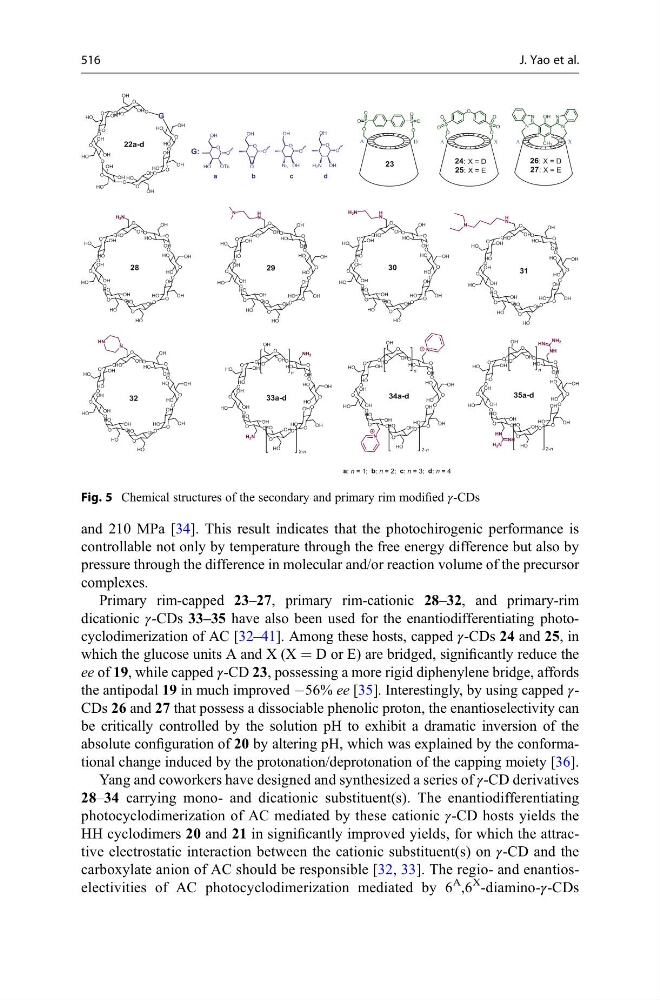
Primary rim-capped 23–27, primary rim-cationic 28–32, and primary-rim
dicationic γ-CDs 33–35 have also been used for the enantiodifferentiating photocyclodimerization of AC [32–41]. Among these hosts, capped γ-CDs 24 and 25, in
which the glucose units A and X (X = D or E) are bridged, significantly reduce the
ee of 19, while capped γ-CD 23, possessing a more rigid diphenylene bridge, affords
the antipodal 19 in much improved À56% ee [35]. Interestingly, by using capped γCDs 26 and 27 that possess a dissociable phenolic proton, the enantioselectivity can
be critically controlled by the solution pH to exhibit a dramatic inversion of the
absolute configuration of 20 by altering pH, which was explained by the conformational change induced by the protonation/deprotonation of the capping moiety [36].
Yang and coworkers have designed and synthesized a series of γ-CD derivatives
28–34 carrying mono- and dicationic substituent(s). The enantiodifferentiating
photocyclodimerization of AC mediated by these cationic γ-CD hosts yields the
HH cyclodimers 20 and 21 in significantly improved yields, for which the attractive electrostatic interaction between the cationic substituent(s) on γ-CD and the
carboxylate anion of AC should be responsible [32, 33]. The regio- and enantioselectivities of AC photocyclodimerization mediated by 6
A ,6
X -diamino-γ-CDs
Fig. 5 Chemical structures of the secondary and primary rim modified γ-CDs
516
J. Yao et al.