

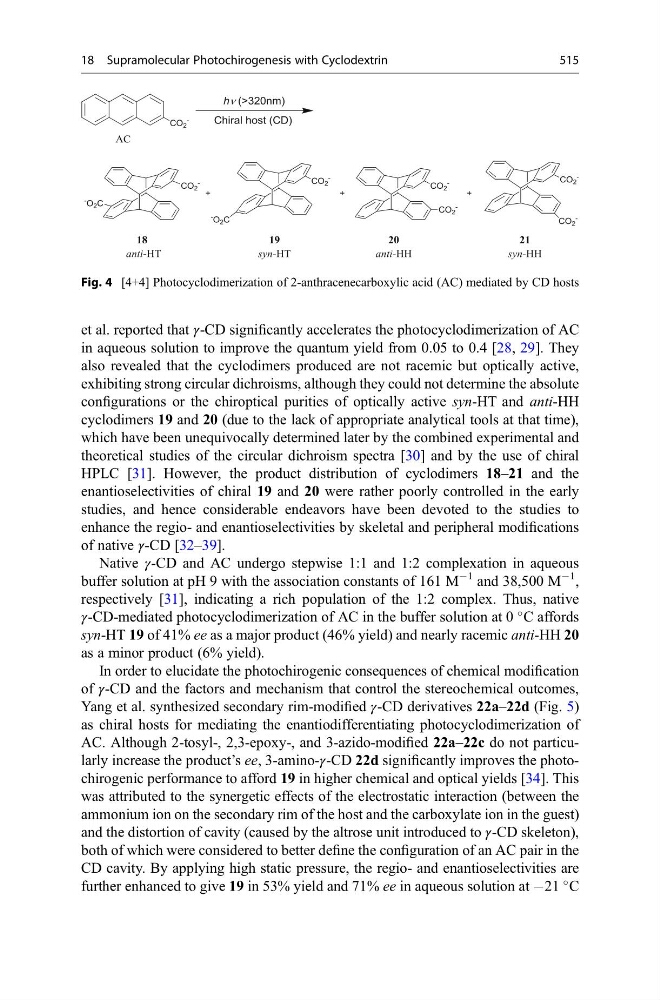
et al. reported that γ-CD significantly accelerates the photocyclodimerization of AC
in aqueous solution to improve the quantum yield from 0.05 to 0.4 [28, 29]. They
also revealed that the cyclodimers produced are not racemic but optically active,
exhibiting strong circular dichroisms, although they could not determine the absolute
configurations or the chiroptical purities of optically active syn-HT and anti-HH
cyclodimers 19 and 20 (due to the lack of appropriate analytical tools at that time),
which have been unequivocally determined later by the combined experimental and
theoretical studies of the circular dichroism spectra [30] and by the use of chiral
HPLC [31]. However, the product distribution of cyclodimers 18–21 and the
enantioselectivities of chiral 19 and 20 were rather poorly controlled in the early
studies, and hence considerable endeavors have been devoted to the studies to
enhance the regio- and enantioselectivities by skeletal and peripheral modifications
of native γ-CD [32–39].
Native γ-CD and AC undergo stepwise 1:1 and 1:2 complexation in aqueous
buffer solution at pH 9 with the association constants of 161 M
À1 and 38,500 M
À1 ,
respectively [31], indicating a rich population of the 1:2 complex. Thus, native
γ-CD-mediated photocyclodimerization of AC in the buffer solution at 0
C affords
syn-HT 19 of 41% ee as a major product (46% yield) and nearly racemic anti-HH 20
as a minor product (6% yield).
In order to elucidate the photochirogenic consequences of chemical modification
of γ-CD and the factors and mechanism that control the stereochemical outcomes,
Yang et al. synthesized secondary rim-modified γ-CD derivatives 22a–22d (Fig. 5)
as chiral hosts for mediating the enantiodifferentiating photocyclodimerization of
AC. Although 2-tosyl-, 2,3-epoxy-, and 3-azido-modified 22a–22c do not particularly increase the product’s ee, 3-amino-γ-CD 22d significantly improves the photochirogenic performance to afford 19 in higher chemical and optical yields [34]. This
was attributed to the synergetic effects of the electrostatic interaction (between the
ammonium ion on the secondary rim of the host and the carboxylate ion in the guest)
and the distortion of cavity (caused by the altrose unit introduced to γ-CD skeleton),
both of which were considered to better define the configuration of an AC pair in the
CD cavity. By applying high static pressure, the regio- and enantioselectivities are
further enhanced to give 19 in 53% yield and 71% ee in aqueous solution at À21
C
Fig. 4 [4+4] Photocyclodimerization of 2-anthracenecarboxylic acid (AC) mediated by CD hosts
18 Supramolecular Photochirogenesis with Cyclodextrin
515