

benzene derivative, in its cavity (6–8 Å in diameter) [13b]. In rather exceptional
cases [21, 27], β-CD forms a higher-order 2:2 complex with certain guest molecules
to facilitate the subsequent bimolecular photoreaction. Possessing the largest cavity
(8–10 Å in diameter) [13b] among the three commercially available CDs, γ-CD can
accommodate two medium-sized flat molecules, such as fused aromatics, to function
as a chiral molecular container for bimolecular reaction. Since the affinities of
organic guests toward native CDs are modest in general and the hydrophobic
interaction operative between the host and guest is nondirectional in nature, introducing functional group(s) is an often employed and indeed effectual strategy for
enhancing the binding affinity and also for enforcing specific orientation and conformation to the substrate(s) in the cavity.
18.3.1 Enantiodifferentiating Photodimerization of Benzaldehyde
Mediated by Native b-CD
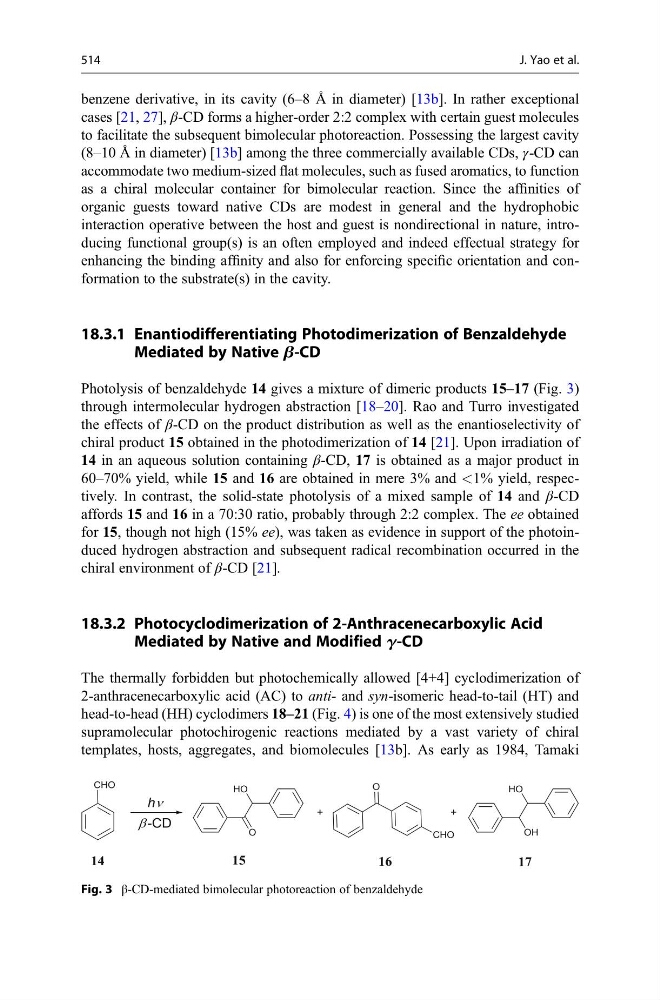
Photolysis of benzaldehyde 14 gives a mixture of dimeric products 15–17 (Fig. 3)
through intermolecular hydrogen abstraction [18–20]. Rao and Turro investigated
the effects of β-CD on the product distribution as well as the enantioselectivity of
chiral product 15 obtained in the photodimerization of 14 [21]. Upon irradiation of
14 in an aqueous solution containing β-CD, 17 is obtained as a major product in
60–70% yield, while 15 and 16 are obtained in mere 3% and <1% yield, respectively. In contrast, the solid-state photolysis of a mixed sample of 14 and β-CD
affords 15 and 16 in a 70:30 ratio, probably through 2:2 complex. The ee obtained
for 15, though not high (15% ee), was taken as evidence in support of the photoinduced hydrogen abstraction and subsequent radical recombination occurred in the
chiral environment of β-CD [21].
18.3.2 Photocyclodimerization of 2-Anthracenecarboxylic Acid
Mediated by Native and Modified g-CD
The thermally forbidden but photochemically allowed [4+4] cyclodimerization of
2-anthracenecarboxylic acid (AC) to anti- and syn-isomeric head-to-tail (HT) and
head-to-head (HH) cyclodimers 18–21 (Fig. 4) is one of the most extensively studied
supramolecular photochirogenic reactions mediated by a vast variety of chiral
templates, hosts, aggregates, and biomolecules [13b]. As early as 1984, Tamaki
Fig. 3 β-CD-mediated bimolecular photoreaction of benzaldehyde
514
J. Yao et al.