

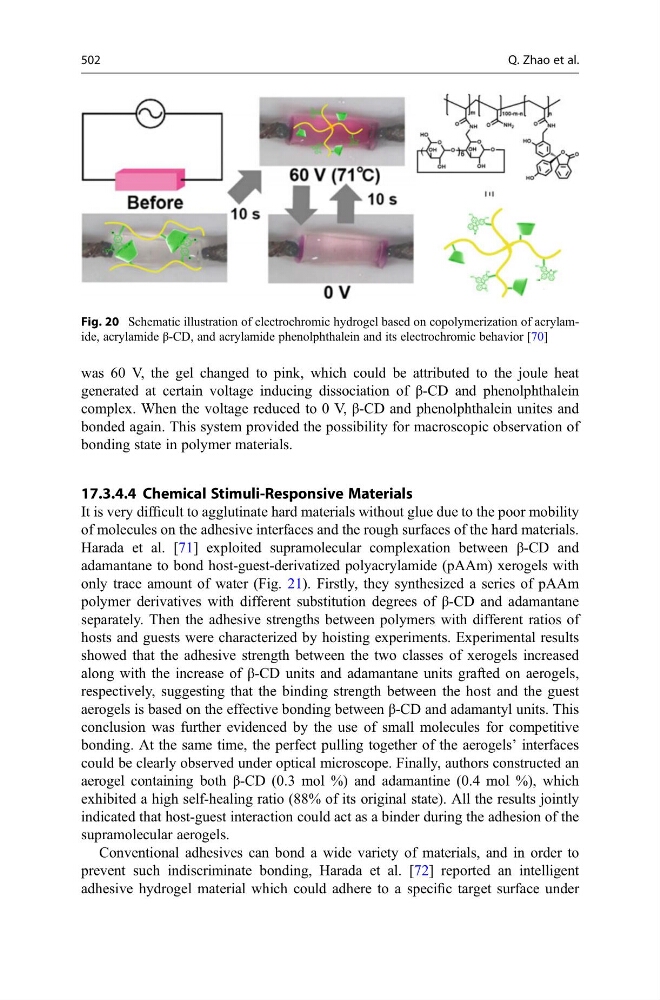
was 60 V, the gel changed to pink, which could be attributed to the joule heat
generated at certain voltage inducing dissociation of β-CD and phenolphthalein
complex. When the voltage reduced to 0 V, β-CD and phenolphthalein unites and
bonded again. This system provided the possibility for macroscopic observation of
bonding state in polymer materials.
17.3.4.4 Chemical Stimuli-Responsive Materials
It is very difficult to agglutinate hard materials without glue due to the poor mobility
of molecules on the adhesive interfaces and the rough surfaces of the hard materials.
Harada et al. [71] exploited supramolecular complexation between β-CD and
adamantane to bond host-guest-derivatized polyacrylamide (pAAm) xerogels with
only trace amount of water (Fig. 21). Firstly, they synthesized a series of pAAm
polymer derivatives with different substitution degrees of β-CD and adamantane
separately. Then the adhesive strengths between polymers with different ratios of
hosts and guests were characterized by hoisting experiments. Experimental results
showed that the adhesive strength between the two classes of xerogels increased
along with the increase of β-CD units and adamantane units grafted on aerogels,
respectively, suggesting that the binding strength between the host and the guest
aerogels is based on the effective bonding between β-CD and adamantyl units. This
conclusion was further evidenced by the use of small molecules for competitive
bonding. At the same time, the perfect pulling together of the aerogels’ interfaces
could be clearly observed under optical microscope. Finally, authors constructed an
aerogel containing both β-CD (0.3 mol %) and adamantine (0.4 mol %), which
exhibited a high self-healing ratio (88% of its original state). All the results jointly
indicated that host-guest interaction could act as a binder during the adhesion of the
supramolecular aerogels.
Conventional adhesives can bond a wide variety of materials, and in order to
prevent such indiscriminate bonding, Harada et al. [72] reported an intelligent
adhesive hydrogel material which could adhere to a specific target surface under
Fig. 20 Schematic illustration of electrochromic hydrogel based on copolymerization of acrylamide, acrylamide β-CD, and acrylamide phenolphthalein and its electrochromic behavior [70]
502
Q. Zhao et al.