

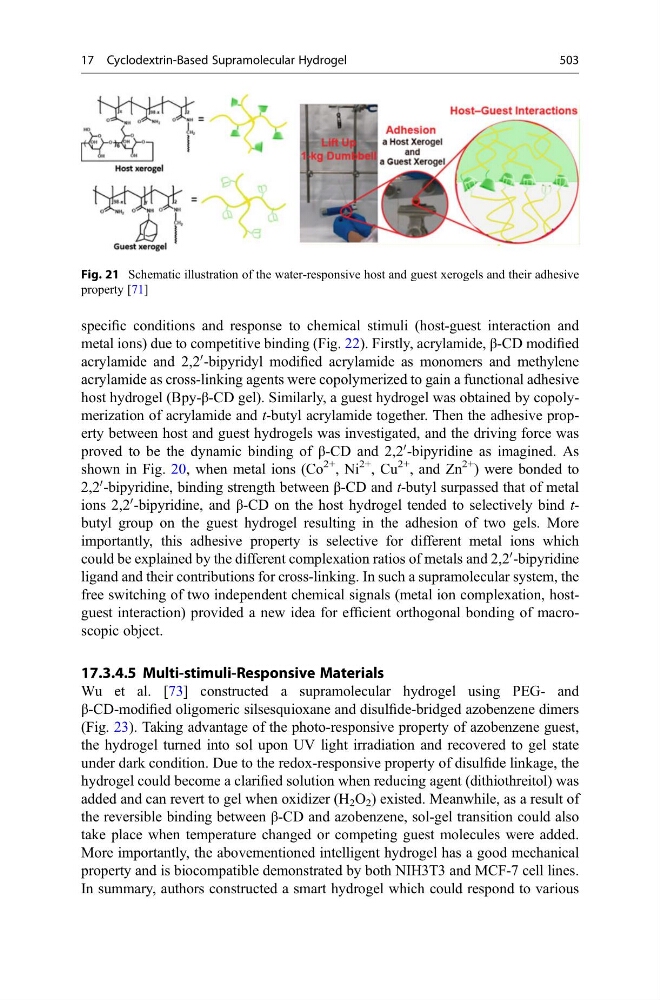
specific conditions and response to chemical stimuli (host-guest interaction and
metal ions) due to competitive binding (Fig. 22). Firstly, acrylamide, β-CD modified
acrylamide and 2,2
0 -bipyridyl modified acrylamide as monomers and methylene
acrylamide as cross-linking agents were copolymerized to gain a functional adhesive
host hydrogel (Bpy-β-CD gel). Similarly, a guest hydrogel was obtained by copolymerization of acrylamide and t-butyl acrylamide together. Then the adhesive property between host and guest hydrogels was investigated, and the driving force was
proved to be the dynamic binding of β-CD and 2,2
0 -bipyridine as imagined. As
shown in Fig. 20, when metal ions (Co
2+ , Ni
2+ , Cu
2+ , and Zn
2+ ) were bonded to
2,2
0 -bipyridine, binding strength between β-CD and t-butyl surpassed that of metal
ions 2,2
0 -bipyridine, and β-CD on the host hydrogel tended to selectively bind tbutyl group on the guest hydrogel resulting in the adhesion of two gels. More
importantly, this adhesive property is selective for different metal ions which
could be explained by the different complexation ratios of metals and 2,2
0 -bipyridine
ligand and their contributions for cross-linking. In such a supramolecular system, the
free switching of two independent chemical signals (metal ion complexation, hostguest interaction) provided a new idea for efficient orthogonal bonding of macroscopic object.
17.3.4.5 Multi-stimuli-Responsive Materials
Wu et al. [73] constructed a supramolecular hydrogel using PEG- and
β-CD-modified oligomeric silsesquioxane and disulfide-bridged azobenzene dimers
(Fig. 23). Taking advantage of the photo-responsive property of azobenzene guest,
the hydrogel turned into sol upon UV light irradiation and recovered to gel state
under dark condition. Due to the redox-responsive property of disulfide linkage, the
hydrogel could become a clarified solution when reducing agent (dithiothreitol) was
added and can revert to gel when oxidizer (H 2 O 2 ) existed. Meanwhile, as a result of
the reversible binding between β-CD and azobenzene, sol-gel transition could also
take place when temperature changed or competing guest molecules were added.
More importantly, the abovementioned intelligent hydrogel has a good mechanical
property and is biocompatible demonstrated by both NIH3T3 and MCF-7 cell lines.
In summary, authors constructed a smart hydrogel which could respond to various
Fig. 21 Schematic illustration of the water-responsive host and guest xerogels and their adhesive
property [71]
17 Cyclodextrin-Based Supramolecular Hydrogel
503