

coefficient (f) and the thickness of the filter (d). In general, f is a fixed value for a
certain filtration membrane. Authors constructed a CD hydrogel by cross-linking the
PPRs based on α-CDs and PEG chains. However, in this work, f value of the
hydrogel film changed sharply between two different values at a very small critical
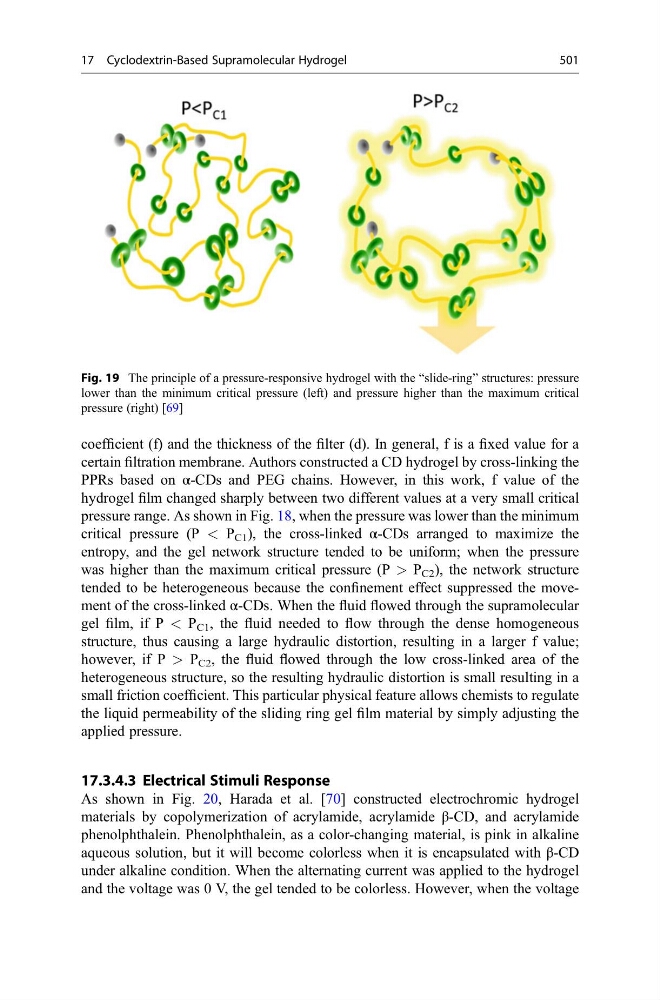
pressure range. As shown in Fig. 18, when the pressure was lower than the minimum
critical pressure (P < P C1 ), the cross-linked α-CDs arranged to maximize the
entropy, and the gel network structure tended to be uniform; when the pressure
was higher than the maximum critical pressure (P > P C2 ), the network structure
tended to be heterogeneous because the confinement effect suppressed the movement of the cross-linked α-CDs. When the fluid flowed through the supramolecular
gel film, if P < P C1 , the fluid needed to flow through the dense homogeneous
structure, thus causing a large hydraulic distortion, resulting in a larger f value;
however, if P > P C2 , the fluid flowed through the low cross-linked area of the
heterogeneous structure, so the resulting hydraulic distortion is small resulting in a
small friction coefficient. This particular physical feature allows chemists to regulate
the liquid permeability of the sliding ring gel film material by simply adjusting the
applied pressure.
17.3.4.3 Electrical Stimuli Response
As shown in Fig. 20, Harada et al. [70] constructed electrochromic hydrogel
materials by copolymerization of acrylamide, acrylamide β-CD, and acrylamide
phenolphthalein. Phenolphthalein, as a color-changing material, is pink in alkaline
aqueous solution, but it will become colorless when it is encapsulated with β-CD
under alkaline condition. When the alternating current was applied to the hydrogel
and the voltage was 0 V, the gel tended to be colorless. However, when the voltage
Fig. 19 The principle of a pressure-responsive hydrogel with the “slide-ring” structures: pressure
lower than the minimum critical pressure (left) and pressure higher than the maximum critical
pressure (right) [69]
17 Cyclodextrin-Based Supramolecular Hydrogel
501