

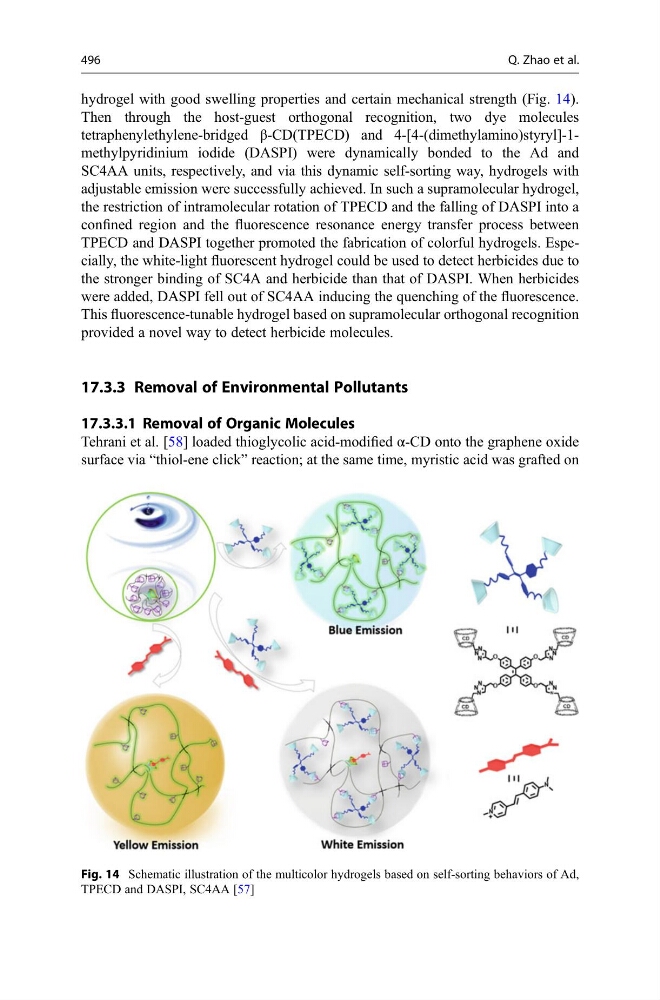
hydrogel with good swelling properties and certain mechanical strength (Fig. 14).
Then through the host-guest orthogonal recognition, two dye molecules
tetraphenylethylene-bridged β-CD(TPECD) and 4-[4-(dimethylamino)styryl]-1methylpyridinium iodide (DASPI) were dynamically bonded to the Ad and
SC4AA units, respectively, and via this dynamic self-sorting way, hydrogels with
adjustable emission were successfully achieved. In such a supramolecular hydrogel,
the restriction of intramolecular rotation of TPECD and the falling of DASPI into a
confined region and the fluorescence resonance energy transfer process between
TPECD and DASPI together promoted the fabrication of colorful hydrogels. Especially, the white-light fluorescent hydrogel could be used to detect herbicides due to
the stronger binding of SC4A and herbicide than that of DASPI. When herbicides
were added, DASPI fell out of SC4AA inducing the quenching of the fluorescence.
This fluorescence-tunable hydrogel based on supramolecular orthogonal recognition
provided a novel way to detect herbicide molecules.
17.3.3 Removal of Environmental Pollutants
17.3.3.1 Removal of Organic Molecules
Tehrani et al. [58] loaded thioglycolic acid-modified α-CD onto the graphene oxide
surface via “thiol-ene click” reaction; at the same time, myristic acid was grafted on
Fig. 14 Schematic illustration of the multicolor hydrogels based on self-sorting behaviors of Ad,
TPECD and DASPI, SC4AA [57]
496
Q. Zhao et al.