

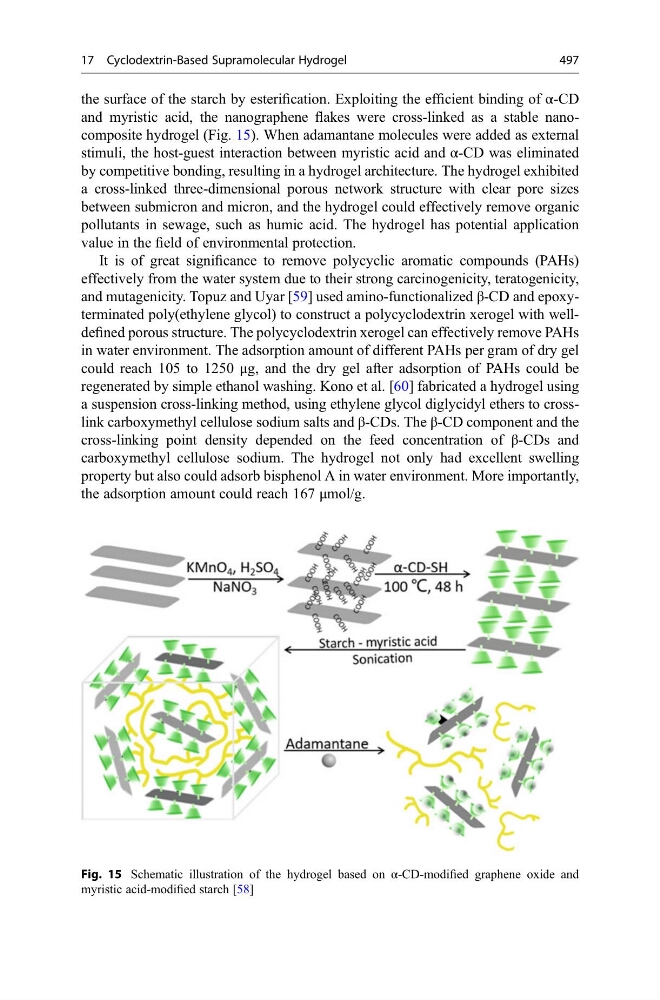
the surface of the starch by esterification. Exploiting the efficient binding of α-CD
and myristic acid, the nanographene flakes were cross-linked as a stable nanocomposite hydrogel (Fig. 15). When adamantane molecules were added as external
stimuli, the host-guest interaction between myristic acid and α-CD was eliminated
by competitive bonding, resulting in a hydrogel architecture. The hydrogel exhibited
a cross-linked three-dimensional porous network structure with clear pore sizes
between submicron and micron, and the hydrogel could effectively remove organic
pollutants in sewage, such as humic acid. The hydrogel has potential application
value in the field of environmental protection.
It is of great significance to remove polycyclic aromatic compounds (PAHs)
effectively from the water system due to their strong carcinogenicity, teratogenicity,
and mutagenicity. Topuz and Uyar [59] used amino-functionalized β-CD and epoxyterminated poly(ethylene glycol) to construct a polycyclodextrin xerogel with welldefined porous structure. The polycyclodextrin xerogel can effectively remove PAHs
in water environment. The adsorption amount of different PAHs per gram of dry gel
could reach 105 to 1250 μg, and the dry gel after adsorption of PAHs could be
regenerated by simple ethanol washing. Kono et al. [60] fabricated a hydrogel using
a suspension cross-linking method, using ethylene glycol diglycidyl ethers to crosslink carboxymethyl cellulose sodium salts and β-CDs. The β-CD component and the
cross-linking point density depended on the feed concentration of β-CDs and
carboxymethyl cellulose sodium. The hydrogel not only had excellent swelling
property but also could adsorb bisphenol A in water environment. More importantly,
the adsorption amount could reach 167 μmol/g.
Fig. 15 Schematic illustration of the hydrogel based on α-CD-modified graphene oxide and
myristic acid-modified starch [58]
17 Cyclodextrin-Based Supramolecular Hydrogel
497