

an important part of the ion-induced hydrogel. Finally, a broad-spectrum antibacterial agent chlorhexidine was chosen to be loaded on the sponge and against
S. aureus bacteria experiment showed up to 30 days in agar diffusion tests. Therefore, this supramolecular hydrogel could open a window for the fabrication of novel
antibacterial materials.
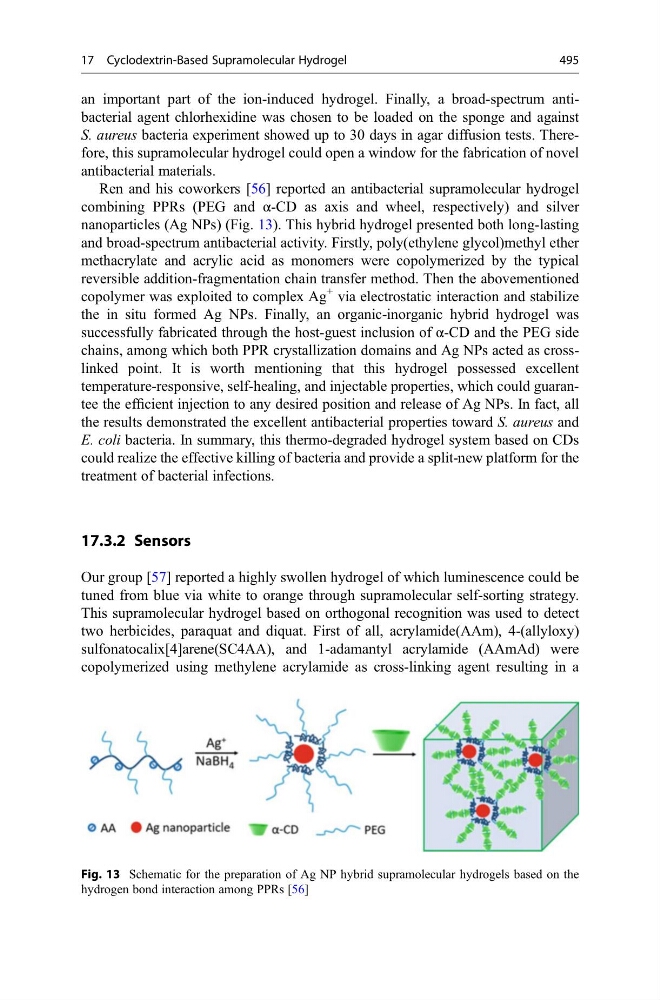
Ren and his coworkers [56] reported an antibacterial supramolecular hydrogel
combining PPRs (PEG and α-CD as axis and wheel, respectively) and silver
nanoparticles (Ag NPs) (Fig. 13). This hybrid hydrogel presented both long-lasting
and broad-spectrum antibacterial activity. Firstly, poly(ethylene glycol)methyl ether
methacrylate and acrylic acid as monomers were copolymerized by the typical
reversible addition-fragmentation chain transfer method. Then the abovementioned
copolymer was exploited to complex Ag
+ via electrostatic interaction and stabilize
the in situ formed Ag NPs. Finally, an organic-inorganic hybrid hydrogel was
successfully fabricated through the host-guest inclusion of α-CD and the PEG side
chains, among which both PPR crystallization domains and Ag NPs acted as crosslinked point. It is worth mentioning that this hydrogel possessed excellent
temperature-responsive, self-healing, and injectable properties, which could guarantee the efficient injection to any desired position and release of Ag NPs. In fact, all
the results demonstrated the excellent antibacterial properties toward S. aureus and
E. coli bacteria. In summary, this thermo-degraded hydrogel system based on CDs
could realize the effective killing of bacteria and provide a split-new platform for the
treatment of bacterial infections.
17.3.2 Sensors
Our group [57] reported a highly swollen hydrogel of which luminescence could be
tuned from blue via white to orange through supramolecular self-sorting strategy.
This supramolecular hydrogel based on orthogonal recognition was used to detect
two herbicides, paraquat and diquat. First of all, acrylamide(AAm), 4-(allyloxy)
sulfonatocalix[4]arene(SC4AA), and 1-adamantyl acrylamide (AAmAd) were
copolymerized using methylene acrylamide as cross-linking agent resulting in a
Fig. 13 Schematic for the preparation of Ag NP hybrid supramolecular hydrogels based on the
hydrogen bond interaction among PPRs [56]
17 Cyclodextrin-Based Supramolecular Hydrogel
495