

nanocomposite hydrogel with injectable and NIR-, pH-, and temperature-responsive
properties showed potential value for chemo-, photo-, and thermal-synergistic cancer
therapy.
17.3.1.2 Antibacterial Materials
Bacterial infection is still a major threat to human life and health worldwide;
therefore, it’s of great importance to investigate antibacterial materials with longlasting, antimicrobial-resistant, broad-spectrum-covered, biocompatible properties
as antibiotic medicine or wound dressing sponge. CD hydrogels as a class of
biocompatible nanocomposite material are highly desired as carriers of fungicides.
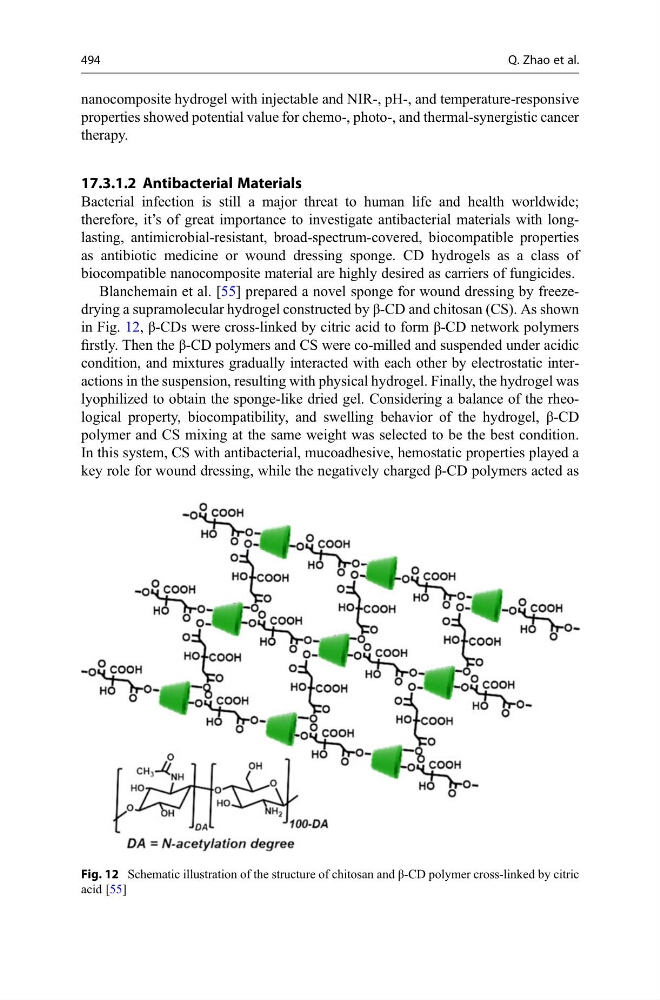
Blanchemain et al. [55] prepared a novel sponge for wound dressing by freezedrying a supramolecular hydrogel constructed by β-CD and chitosan (CS). As shown
in Fig. 12, β-CDs were cross-linked by citric acid to form β-CD network polymers
firstly. Then the β-CD polymers and CS were co-milled and suspended under acidic
condition, and mixtures gradually interacted with each other by electrostatic interactions in the suspension, resulting with physical hydrogel. Finally, the hydrogel was
lyophilized to obtain the sponge-like dried gel. Considering a balance of the rheological property, biocompatibility, and swelling behavior of the hydrogel, β-CD
polymer and CS mixing at the same weight was selected to be the best condition.
In this system, CS with antibacterial, mucoadhesive, hemostatic properties played a
key role for wound dressing, while the negatively charged β-CD polymers acted as
Fig. 12 Schematic illustration of the structure of chitosan and β-CD polymer cross-linked by citric
acid [55]
494
Q. Zhao et al.