

drug (DOX) with the classic guest matched with β-CD (adamantane). Through
non-covalent binding of the β-CD dendritic polymers and the prodrug, supramolecular complexes were obtained. Finally, a series of supramolecular hydrogels loading
anticancer drugs were formed by further “thiol-ene click reaction” between the
complexes and oligoethylene glycol thiosuccinate (another PEG derivative) in situ.
These obtained hydrogels possessing the shear-thinning properties can be injected to
the lesion site conveniently. More importantly, under the acidic environment within
the cancer cells, the benzoyl bond linking DOX and adamantane could be cut off,
thus allowing the release of anticancer drugs. This CD-based hydrogel system
provided a new strategy to improve the stability of supramolecular prodrug for
localized treatment of cancer.
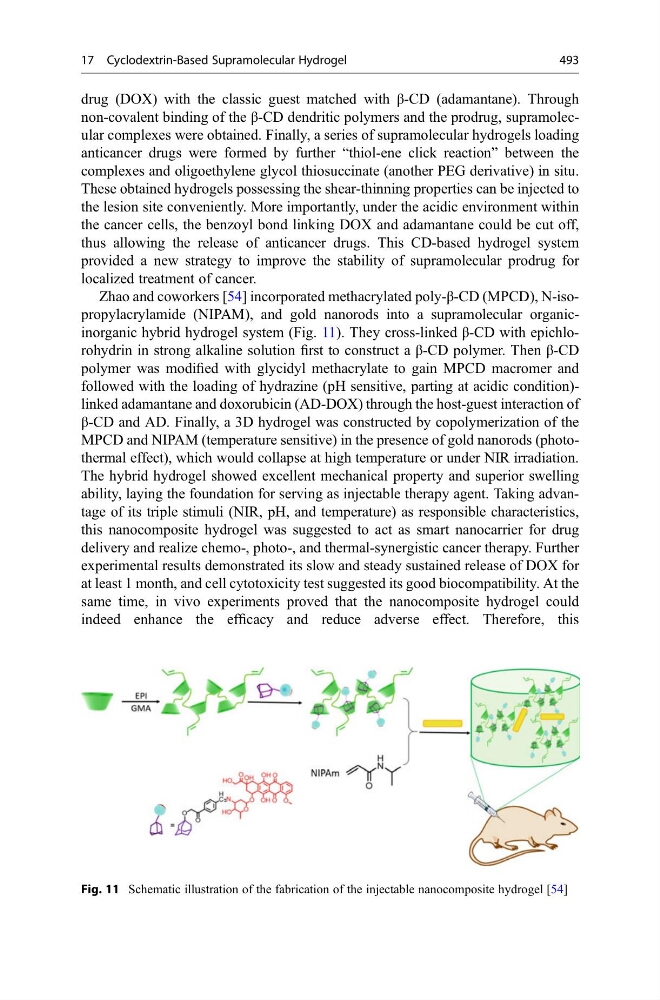
Zhao and coworkers [54] incorporated methacrylated poly-β-CD (MPCD), N-isopropylacrylamide (NIPAM), and gold nanorods into a supramolecular organicinorganic hybrid hydrogel system (Fig. 11). They cross-linked β-CD with epichlorohydrin in strong alkaline solution first to construct a β-CD polymer. Then β-CD
polymer was modified with glycidyl methacrylate to gain MPCD macromer and
followed with the loading of hydrazine (pH sensitive, parting at acidic condition)linked adamantane and doxorubicin (AD-DOX) through the host-guest interaction of
β-CD and AD. Finally, a 3D hydrogel was constructed by copolymerization of the
MPCD and NIPAM (temperature sensitive) in the presence of gold nanorods (photothermal effect), which would collapse at high temperature or under NIR irradiation.
The hybrid hydrogel showed excellent mechanical property and superior swelling
ability, laying the foundation for serving as injectable therapy agent. Taking advantage of its triple stimuli (NIR, pH, and temperature) as responsible characteristics,
this nanocomposite hydrogel was suggested to act as smart nanocarrier for drug
delivery and realize chemo-, photo-, and thermal-synergistic cancer therapy. Further
experimental results demonstrated its slow and steady sustained release of DOX for
at least 1 month, and cell cytotoxicity test suggested its good biocompatibility. At the
same time, in vivo experiments proved that the nanocomposite hydrogel could
indeed enhance the efficacy and reduce adverse effect. Therefore, this
Fig. 11 Schematic illustration of the fabrication of the injectable nanocomposite hydrogel [54]
17 Cyclodextrin-Based Supramolecular Hydrogel
493