

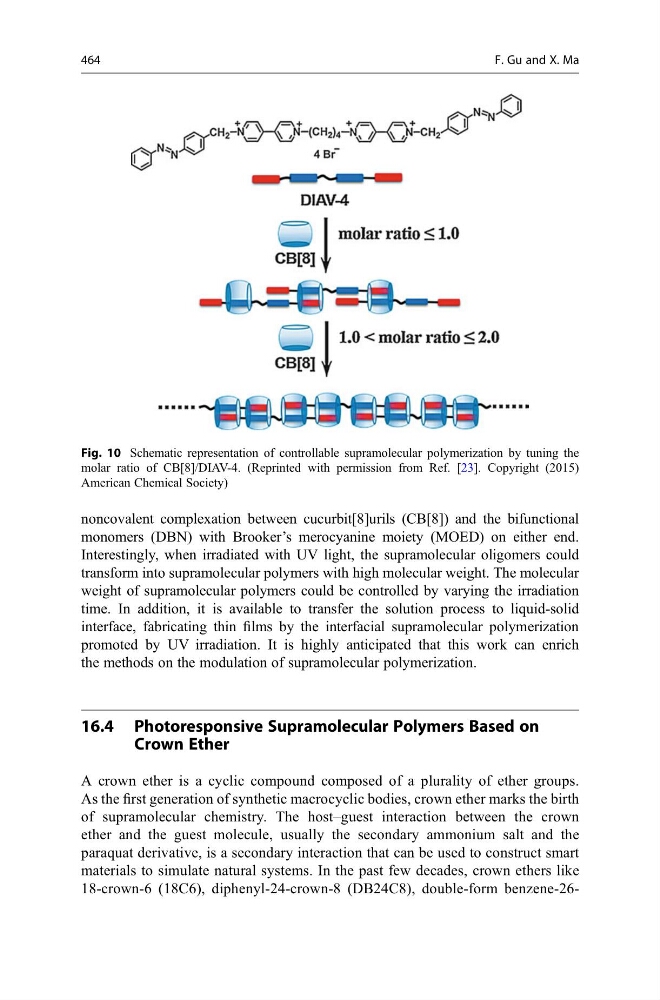
noncovalent complexation between cucurbit[8]urils (CB[8]) and the bifunctional
monomers (DBN) with Brooker’s merocyanine moiety (MOED) on either end.
Interestingly, when irradiated with UV light, the supramolecular oligomers could
transform into supramolecular polymers with high molecular weight. The molecular
weight of supramolecular polymers could be controlled by varying the irradiation
time. In addition, it is available to transfer the solution process to liquid-solid
interface, fabricating thin films by the interfacial supramolecular polymerization
promoted by UV irradiation. It is highly anticipated that this work can enrich
the methods on the modulation of supramolecular polymerization.
16.4 Photoresponsive Supramolecular Polymers Based on
Crown Ether
A crown ether is a cyclic compound composed of a plurality of ether groups.
As the first generation of synthetic macrocyclic bodies, crown ether marks the birth
of supramolecular chemistry. The host–guest interaction between the crown
ether and the guest molecule, usually the secondary ammonium salt and the
paraquat derivative, is a secondary interaction that can be used to construct smart
materials to simulate natural systems. In the past few decades, crown ethers like
18-crown-6 (18C6), diphenyl-24-crown-8 (DB24C8), double-form benzene-26Fig. 10 Schematic representation of controllable supramolecular polymerization by tuning the
molar ratio of CB[8]/DIAV-4. (Reprinted with permission from Ref. [23]. Copyright (2015)
American Chemical Society)
464
F. Gu and X. Ma