

Xu et al. (2015) [11] reported a new kind of drug carrier constructed by supramolecular polymers. Due that the prolonged ultraviolet (UV) exposure is harmful to
cells and UV light has limited tissue penetration ability, this system offers a solution
using a magnetic field to aggregate microcapsules to an accurate area and then
release the drug upon UV light. The grafted β-CD of CD-g-DexO and AD-PASP
will be broken down in an acidic tumor environment, leading to the release of drugs
to the certain location. This research of the drug carrier is expectedly designed as
multimodal functional imaging probe for treatment of cancer.
Zhao et al. (2017) [12] incorporated gold nanorods (GNRs) into the hydrogel
networks formed by the copolymerization of N-isopropylacrylamide (NIPAm)
and methacrylated poly-β-cyclodextrin (MPCD)-based macromere to fabricate an
injectable and near-infrared (NIR)/pH responsive poly(NIPAm-co-MPCD)/GNRs
nanocomposite hydrogel, which could serve as a long-acting implant for chemophotothermal synergistic cancer therapy, shown in Fig. 5. The nanocomposite hydrogel
showed superior mechanical and swelling properties, gelation characteristics, and
excellent NIR-responsive property. A hydrophobic acid-labile adamantane-modified
doxorubicin (AD-DOX) prodrug was loaded into the hydrogel efficiently by
host–guest interaction. The nanocomposite hydrogel exhibited a manner of sustained
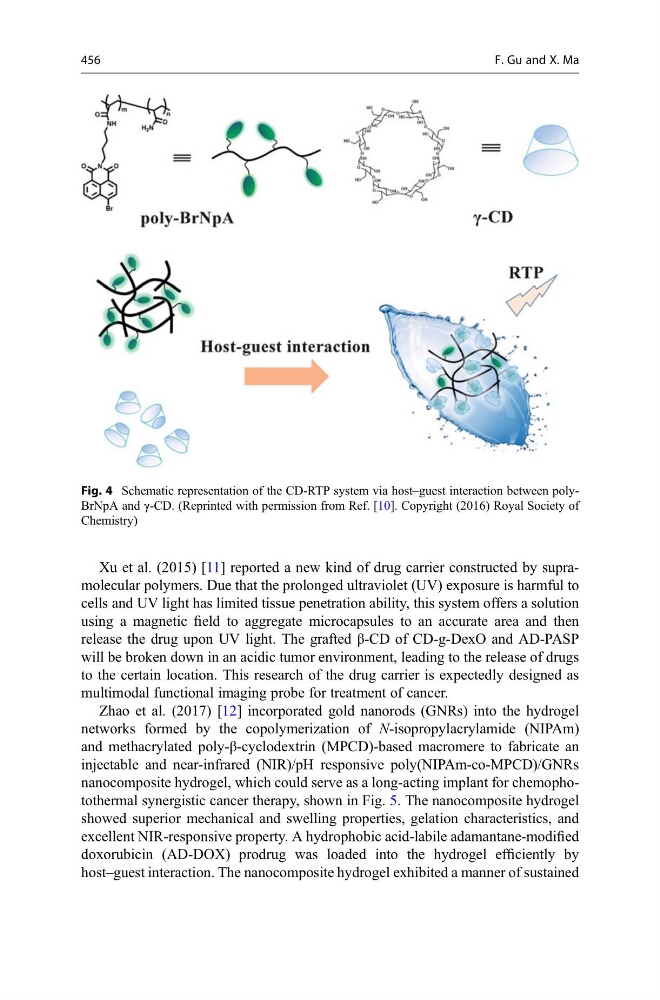
Fig. 4 Schematic representation of the CD-RTP system via host–guest interaction between polyBrNpA and γ-CD. (Reprinted with permission from Ref. [10]. Copyright (2016) Royal Society of
Chemistry)
456
F. Gu and X. Ma
cells and UV light has limited tissue penetration ability, this system offers a solution
using a magnetic field to aggregate microcapsules to an accurate area and then
release the drug upon UV light. The grafted β-CD of CD-g-DexO and AD-PASP
will be broken down in an acidic tumor environment, leading to the release of drugs
to the certain location. This research of the drug carrier is expectedly designed as
multimodal functional imaging probe for treatment of cancer.
Zhao et al. (2017) [12] incorporated gold nanorods (GNRs) into the hydrogel
networks formed by the copolymerization of N-isopropylacrylamide (NIPAm)
and methacrylated poly-β-cyclodextrin (MPCD)-based macromere to fabricate an
injectable and near-infrared (NIR)/pH responsive poly(NIPAm-co-MPCD)/GNRs
nanocomposite hydrogel, which could serve as a long-acting implant for chemophotothermal synergistic cancer therapy, shown in Fig. 5. The nanocomposite hydrogel
showed superior mechanical and swelling properties, gelation characteristics, and
excellent NIR-responsive property. A hydrophobic acid-labile adamantane-modified
doxorubicin (AD-DOX) prodrug was loaded into the hydrogel efficiently by
host–guest interaction. The nanocomposite hydrogel exhibited a manner of sustained
Fig. 4 Schematic representation of the CD-RTP system via host–guest interaction between polyBrNpA and γ-CD. (Reprinted with permission from Ref. [10]. Copyright (2016) Royal Society of
Chemistry)
456
F. Gu and X. Ma