

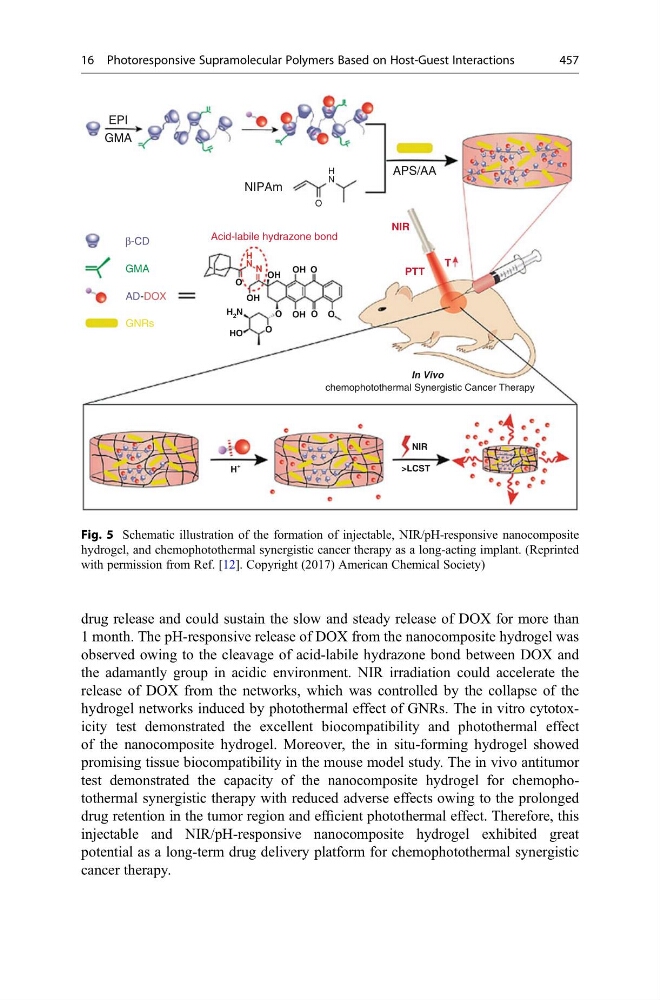
drug release and could sustain the slow and steady release of DOX for more than
1 month. The pH-responsive release of DOX from the nanocomposite hydrogel was
observed owing to the cleavage of acid-labile hydrazone bond between DOX and
the adamantly group in acidic environment. NIR irradiation could accelerate the
release of DOX from the networks, which was controlled by the collapse of the
hydrogel networks induced by photothermal effect of GNRs. The in vitro cytotoxicity test demonstrated the excellent biocompatibility and photothermal effect
of the nanocomposite hydrogel. Moreover, the in situ-forming hydrogel showed
promising tissue biocompatibility in the mouse model study. The in vivo antitumor
test demonstrated the capacity of the nanocomposite hydrogel for chemophotothermal synergistic therapy with reduced adverse effects owing to the prolonged
drug retention in the tumor region and efficient photothermal effect. Therefore, this
injectable and NIR/pH-responsive nanocomposite hydrogel exhibited great
potential as a long-term drug delivery platform for chemophotothermal synergistic
cancer therapy.
EPI
GMA
NIPAm
O
O
O
O
chemophotothermal Synergistic Cancer Therapy
O
OH
OH
HO
H 2 N
OH
H
+
NIR
>LCST
OH
O
In Vivo
H
N N
NIR
Acid-labile hydrazone bond
PTT
T
APS/AA
H
N
O
β-CD
AD-DOX
GMA
GNRs
Fig. 5 Schematic illustration of the formation of injectable, NIR/pH-responsive nanocomposite
hydrogel, and chemophotothermal synergistic cancer therapy as a long-acting implant. (Reprinted
with permission from Ref. [12]. Copyright (2017) American Chemical Society)
16 Photoresponsive Supramolecular Polymers Based on Host-Guest Interactions
457
1 month. The pH-responsive release of DOX from the nanocomposite hydrogel was
observed owing to the cleavage of acid-labile hydrazone bond between DOX and
the adamantly group in acidic environment. NIR irradiation could accelerate the
release of DOX from the networks, which was controlled by the collapse of the
hydrogel networks induced by photothermal effect of GNRs. The in vitro cytotoxicity test demonstrated the excellent biocompatibility and photothermal effect
of the nanocomposite hydrogel. Moreover, the in situ-forming hydrogel showed
promising tissue biocompatibility in the mouse model study. The in vivo antitumor
test demonstrated the capacity of the nanocomposite hydrogel for chemophotothermal synergistic therapy with reduced adverse effects owing to the prolonged
drug retention in the tumor region and efficient photothermal effect. Therefore, this
injectable and NIR/pH-responsive nanocomposite hydrogel exhibited great
potential as a long-term drug delivery platform for chemophotothermal synergistic
cancer therapy.
EPI
GMA
NIPAm
O
O
O
O
chemophotothermal Synergistic Cancer Therapy
O
OH
OH
HO
H 2 N
OH
H
+
NIR
>LCST
OH
O
In Vivo
H
N N
NIR
Acid-labile hydrazone bond
PTT
T
APS/AA
H
N
O
β-CD
AD-DOX
GMA
GNRs
Fig. 5 Schematic illustration of the formation of injectable, NIR/pH-responsive nanocomposite
hydrogel, and chemophotothermal synergistic cancer therapy as a long-acting implant. (Reprinted
with permission from Ref. [12]. Copyright (2017) American Chemical Society)
16 Photoresponsive Supramolecular Polymers Based on Host-Guest Interactions
457