

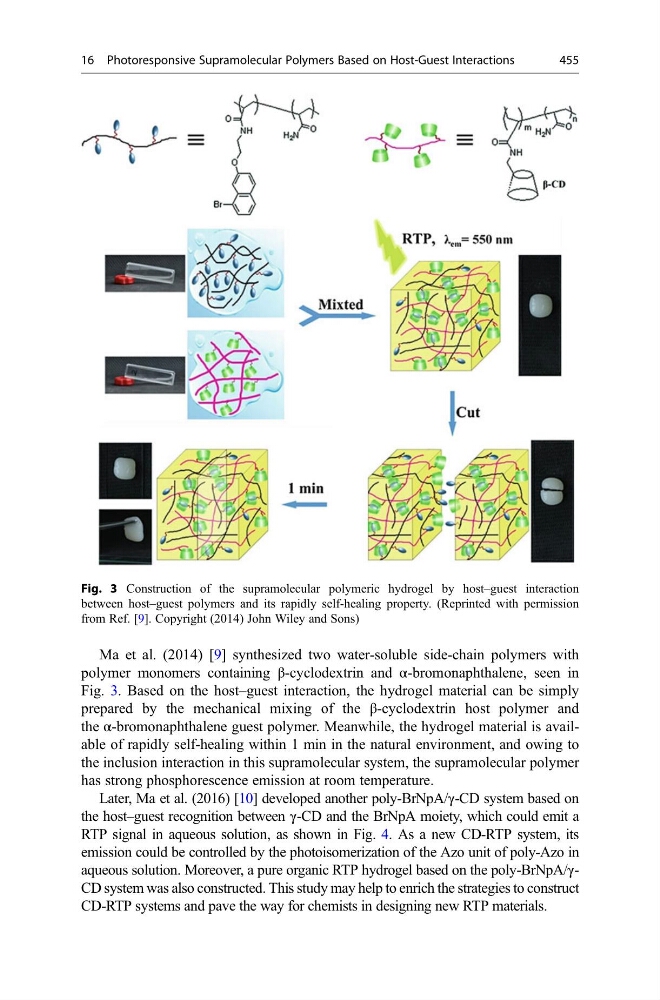
Ma et al. (2014) [9] synthesized two water-soluble side-chain polymers with
polymer monomers containing β-cyclodextrin and α-bromonaphthalene, seen in
Fig. 3. Based on the host–guest interaction, the hydrogel material can be simply
prepared by the mechanical mixing of the β-cyclodextrin host polymer and
the α-bromonaphthalene guest polymer. Meanwhile, the hydrogel material is available of rapidly self-healing within 1 min in the natural environment, and owing to
the inclusion interaction in this supramolecular system, the supramolecular polymer
has strong phosphorescence emission at room temperature.
Later, Ma et al. (2016) [10] developed another poly-BrNpA/γ-CD system based on
the host–guest recognition between γ-CD and the BrNpA moiety, which could emit a
RTP signal in aqueous solution, as shown in Fig. 4. As a new CD-RTP system, its
emission could be controlled by the photoisomerization of the Azo unit of poly-Azo in
aqueous solution. Moreover, a pure organic RTP hydrogel based on the poly-BrNpA/γCD system was also constructed. This study may help to enrich the strategies to construct
CD-RTP systems and pave the way for chemists in designing new RTP materials.
Fig. 3 Construction of the supramolecular polymeric hydrogel by host–guest interaction
between host–guest polymers and its rapidly self-healing property. (Reprinted with permission
from Ref. [9]. Copyright (2014) John Wiley and Sons)
16 Photoresponsive Supramolecular Polymers Based on Host-Guest Interactions
455
polymer monomers containing β-cyclodextrin and α-bromonaphthalene, seen in
Fig. 3. Based on the host–guest interaction, the hydrogel material can be simply
prepared by the mechanical mixing of the β-cyclodextrin host polymer and
the α-bromonaphthalene guest polymer. Meanwhile, the hydrogel material is available of rapidly self-healing within 1 min in the natural environment, and owing to
the inclusion interaction in this supramolecular system, the supramolecular polymer
has strong phosphorescence emission at room temperature.
Later, Ma et al. (2016) [10] developed another poly-BrNpA/γ-CD system based on
the host–guest recognition between γ-CD and the BrNpA moiety, which could emit a
RTP signal in aqueous solution, as shown in Fig. 4. As a new CD-RTP system, its
emission could be controlled by the photoisomerization of the Azo unit of poly-Azo in
aqueous solution. Moreover, a pure organic RTP hydrogel based on the poly-BrNpA/γCD system was also constructed. This study may help to enrich the strategies to construct
CD-RTP systems and pave the way for chemists in designing new RTP materials.
Fig. 3 Construction of the supramolecular polymeric hydrogel by host–guest interaction
between host–guest polymers and its rapidly self-healing property. (Reprinted with permission
from Ref. [9]. Copyright (2014) John Wiley and Sons)
16 Photoresponsive Supramolecular Polymers Based on Host-Guest Interactions
455