

surface-enhanced Raman spectroscopy (SERS). The SERS technique is a very
effective tool to analyze molecules by highly increasing the Raman signal intensity
coming from molecules, which have been adsorbed on nanosized metallic surfaces
[98]. Several organic moleculars, such as 1,10-phenanthroline, dopamine,
aminopyrene, crystal violet, rhodamine B (RB), 4-aminothiophenol, have been
demonstrated that CD-capped Au and Ag NPs exhibit a significant SERS effect to
these molecular probes [99–101].
15.6 Conclusions and Outlooks
The correlative research and developments in the area of functionalized inorganic
nanomaterials, such as carbon, magnetic, semiconductor, and metal nanoparticles,
have emerged into a cutting edge multidisciplinary nanotechnology. Notably, CDs
have been widely used as ideal functional molecules to improve the stability,
solubility, and bioavailability of these inorganic nanoparticles, based on their unique
properties as supermolecular hosts. The remarkable optical, electronic, and magnetic
properties of these inorganic nanoparticles can be combined with the recognition and
inclusion ability of cyclodextrins for the development of multifunctional nanodevices. Such all-in-one nanodevices can bring together all the assets of materials
involved in constructing nanohybrids, in a comprehensive manner, which may lead
to a synergistic effect for sensing, removal or purification, and drug delivery. Thus,
the CD hybrid inorganic nanocomposites offer fast, sensitive, and selective molecular recognition sensors; inexpensive, eco-friendly, high efficient, and recyclable
adsorption-separation system; as well as new nanocomposites designed specifically
to carry anticancer drugs and to treat cancer in virtue of high targeting and multiple
stimuli-responsive brought by synergetic effect of all materials.
Although the construction and application of CD hybrid inorganic nanomaterials
have been widely developed in recent years and achieved some charming advances,
there are still many challenges for scientists. Firstly, the intelligent molecular
recognition platform with more sensitivity and selectivity should be developed, of
which the binding affinities can be adjusted according to response microenvironments for real-time monitoring in vivo. Secondly, the degradation function should be
integrated into the CD hybrid inorganic nano-adsorbents. For the environment
pollution treatment, perfect nano-adsorbents are extremely stable during the
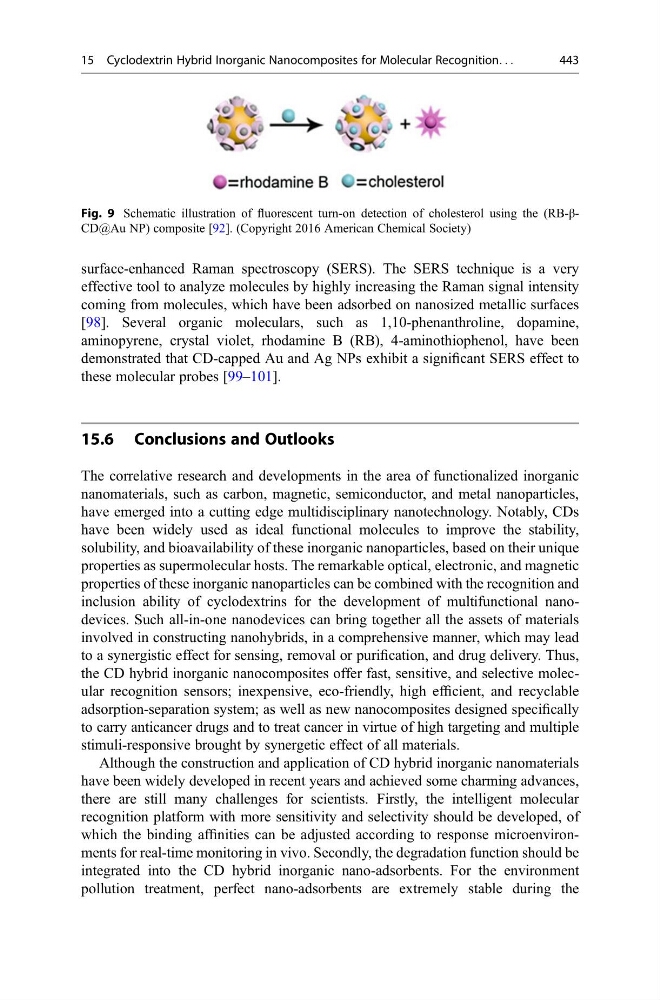
Fig. 9 Schematic illustration of fluorescent turn-on detection of cholesterol using the (RB-βCD@Au NP) composite [92]. (Copyright 2016 American Chemical Society)
15 Cyclodextrin Hybrid Inorganic Nanocomposites for Molecular Recognition. . .
443
effective tool to analyze molecules by highly increasing the Raman signal intensity
coming from molecules, which have been adsorbed on nanosized metallic surfaces
[98]. Several organic moleculars, such as 1,10-phenanthroline, dopamine,
aminopyrene, crystal violet, rhodamine B (RB), 4-aminothiophenol, have been
demonstrated that CD-capped Au and Ag NPs exhibit a significant SERS effect to
these molecular probes [99–101].
15.6 Conclusions and Outlooks
The correlative research and developments in the area of functionalized inorganic
nanomaterials, such as carbon, magnetic, semiconductor, and metal nanoparticles,
have emerged into a cutting edge multidisciplinary nanotechnology. Notably, CDs
have been widely used as ideal functional molecules to improve the stability,
solubility, and bioavailability of these inorganic nanoparticles, based on their unique
properties as supermolecular hosts. The remarkable optical, electronic, and magnetic
properties of these inorganic nanoparticles can be combined with the recognition and
inclusion ability of cyclodextrins for the development of multifunctional nanodevices. Such all-in-one nanodevices can bring together all the assets of materials
involved in constructing nanohybrids, in a comprehensive manner, which may lead
to a synergistic effect for sensing, removal or purification, and drug delivery. Thus,
the CD hybrid inorganic nanocomposites offer fast, sensitive, and selective molecular recognition sensors; inexpensive, eco-friendly, high efficient, and recyclable
adsorption-separation system; as well as new nanocomposites designed specifically
to carry anticancer drugs and to treat cancer in virtue of high targeting and multiple
stimuli-responsive brought by synergetic effect of all materials.
Although the construction and application of CD hybrid inorganic nanomaterials
have been widely developed in recent years and achieved some charming advances,
there are still many challenges for scientists. Firstly, the intelligent molecular
recognition platform with more sensitivity and selectivity should be developed, of
which the binding affinities can be adjusted according to response microenvironments for real-time monitoring in vivo. Secondly, the degradation function should be
integrated into the CD hybrid inorganic nano-adsorbents. For the environment
pollution treatment, perfect nano-adsorbents are extremely stable during the
Fig. 9 Schematic illustration of fluorescent turn-on detection of cholesterol using the (RB-βCD@Au NP) composite [92]. (Copyright 2016 American Chemical Society)
15 Cyclodextrin Hybrid Inorganic Nanocomposites for Molecular Recognition. . .
443