

properties. Thus, a variety of synthetic strategies have been adopted to synthesize
metal NPs with size, shape, and composition control. For application in biological
sensing or in cell imaging, the corresponding nanoparticles must be soluble in water,
and much attention has been paid to the development of green synthetic approaches
leading to aqueous suspensions of nanoparticles. Therefore, CDs have appeared to
be very eco-friendly capping agents for the metal nanoparticles synthesis. The role of
CDs is diverse, ranging from stabilization of the NPs by providing a protective layer
that prevents aggregation to increasing solubility in aqueous media. α-, β-, and
γ-CDs, and their derivatives, have been widely employed to modify metal nanoparticles by interacting with proper guest molecules [90, 91]. In this part, we focus
on the recent advances in the construction of CD-functionalized noble metal nanoparticles and their applications in identification-detection sensing platforms.
CD-coated Au and Ag NPs provide a kind of hybrid nanomaterials which can
pave the way toward novel biological tracers as well as optoelectronic nanosensor.
Generally, a distance-dependent surface plasmon resonance (SPR) band of AuNPs
and AgNPs has been extensively employed for designing assembly-/disassemblymodulated colorimetric sensors. In this case, the high extinction coefficient of
AuNPs and AgNPs permits that they can act as the ideal energy acceptors in
constructing fluorescence resonance energy transfer (FRET) system for sensing
and biosensing [92–97]. For example, a (RB-β-CD@Au NP) composite can be
employed as an energy acceptor for turn-on fluorescent sensing of cholesterol
based on the guest replacement reaction as shown in Fig. 9 [92]. In addition,
β-CD-stabilized Au NPs revealed a unique ability to detect micromolar quantities
of Pb
2+ in the presence of other interfering metal cations, resulting in a visual color
change from red to blue [93]. On the other hand, many systems were demonstrated as
very effective substrates for the detection of various organic compounds using
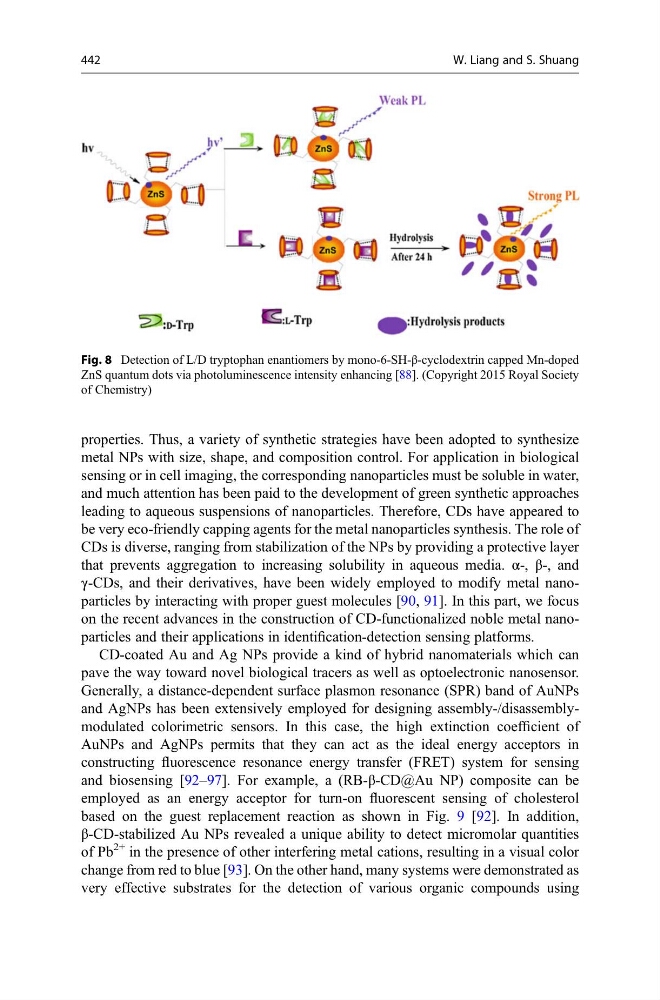
Fig. 8 Detection of L/D tryptophan enantiomers by mono-6-SH-β-cyclodextrin capped Mn-doped
ZnS quantum dots via photoluminescence intensity enhancing [88]. (Copyright 2015 Royal Society
of Chemistry)
442
W. Liang and S. Shuang
metal NPs with size, shape, and composition control. For application in biological
sensing or in cell imaging, the corresponding nanoparticles must be soluble in water,
and much attention has been paid to the development of green synthetic approaches
leading to aqueous suspensions of nanoparticles. Therefore, CDs have appeared to
be very eco-friendly capping agents for the metal nanoparticles synthesis. The role of
CDs is diverse, ranging from stabilization of the NPs by providing a protective layer
that prevents aggregation to increasing solubility in aqueous media. α-, β-, and
γ-CDs, and their derivatives, have been widely employed to modify metal nanoparticles by interacting with proper guest molecules [90, 91]. In this part, we focus
on the recent advances in the construction of CD-functionalized noble metal nanoparticles and their applications in identification-detection sensing platforms.
CD-coated Au and Ag NPs provide a kind of hybrid nanomaterials which can
pave the way toward novel biological tracers as well as optoelectronic nanosensor.
Generally, a distance-dependent surface plasmon resonance (SPR) band of AuNPs
and AgNPs has been extensively employed for designing assembly-/disassemblymodulated colorimetric sensors. In this case, the high extinction coefficient of
AuNPs and AgNPs permits that they can act as the ideal energy acceptors in
constructing fluorescence resonance energy transfer (FRET) system for sensing
and biosensing [92–97]. For example, a (RB-β-CD@Au NP) composite can be
employed as an energy acceptor for turn-on fluorescent sensing of cholesterol
based on the guest replacement reaction as shown in Fig. 9 [92]. In addition,
β-CD-stabilized Au NPs revealed a unique ability to detect micromolar quantities
of Pb
2+ in the presence of other interfering metal cations, resulting in a visual color
change from red to blue [93]. On the other hand, many systems were demonstrated as
very effective substrates for the detection of various organic compounds using
Fig. 8 Detection of L/D tryptophan enantiomers by mono-6-SH-β-cyclodextrin capped Mn-doped
ZnS quantum dots via photoluminescence intensity enhancing [88]. (Copyright 2015 Royal Society
of Chemistry)
442
W. Liang and S. Shuang