

cyclodextrin and drug molecules dominate the pH-responsive drug release from the
DDS. Because of the environment of cancer cells is more acidic than that for healthy
cells, the pH-responsive drug release phenomenon together with the active targeting
process enables an increase in the therapeutic’s pharmaceutical availability and the
reduction of its toxicity. For example, the release ability of doxorubicin (DOX) from
a β-CD-modified rGO nanosheet does not exceed 20% under physiological conditions (pH 7.4, 37
C), but over 60% of DOX is released in an acidic environment (pH
5.3, 37
C) [45]. In addition, it is noteworthy that the photothermal-stimulated drug
releases that utilize the wonderful photothermal conversion performance of carbon
nanomaterial have been provided a valid approach to improve the effect of photothermal therapy [39, 41].
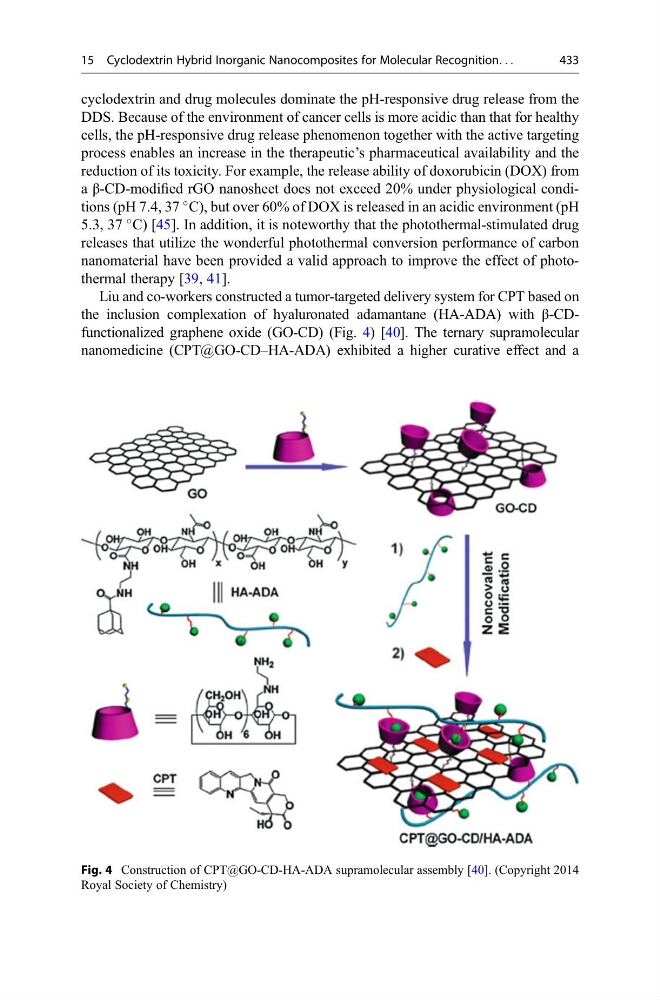
Liu and co-workers constructed a tumor-targeted delivery system for CPT based on
the inclusion complexation of hyaluronated adamantane (HA-ADA) with β-CDfunctionalized graphene oxide (GO-CD) (Fig. 4) [40]. The ternary supramolecular
nanomedicine (CPT@GO-CD–HA-ADA) exhibited a higher curative effect and a
Fig. 4 Construction of CPT@GO-CD-HA-ADA supramolecular assembly [40]. (Copyright 2014
Royal Society of Chemistry)
15 Cyclodextrin Hybrid Inorganic Nanocomposites for Molecular Recognition. . .
433
DDS. Because of the environment of cancer cells is more acidic than that for healthy
cells, the pH-responsive drug release phenomenon together with the active targeting
process enables an increase in the therapeutic’s pharmaceutical availability and the
reduction of its toxicity. For example, the release ability of doxorubicin (DOX) from
a β-CD-modified rGO nanosheet does not exceed 20% under physiological conditions (pH 7.4, 37
C), but over 60% of DOX is released in an acidic environment (pH
5.3, 37
C) [45]. In addition, it is noteworthy that the photothermal-stimulated drug
releases that utilize the wonderful photothermal conversion performance of carbon
nanomaterial have been provided a valid approach to improve the effect of photothermal therapy [39, 41].
Liu and co-workers constructed a tumor-targeted delivery system for CPT based on
the inclusion complexation of hyaluronated adamantane (HA-ADA) with β-CDfunctionalized graphene oxide (GO-CD) (Fig. 4) [40]. The ternary supramolecular
nanomedicine (CPT@GO-CD–HA-ADA) exhibited a higher curative effect and a
Fig. 4 Construction of CPT@GO-CD-HA-ADA supramolecular assembly [40]. (Copyright 2014
Royal Society of Chemistry)
15 Cyclodextrin Hybrid Inorganic Nanocomposites for Molecular Recognition. . .
433