

Schoenfisch and coworkers reported a series of N-diazeniumdiolatefunctionalized β-CD derivatives as NO carriers to release NO under acidic conditions. The authors introduced amine on the primary rim of β-CD via a hydroxyl
substitution reaction (Fig. 19a), then the amine-CD derivatives (mono- and heptasubstituted) were treated with NO gas under high pressure (10 bars) and strong
alkaline conditions to prepare N-diazeniumdiolate-modified CD derivatives. Each
molecule of diazeniumdiolate will release two molecules of NO, triggered by proton
cations in lower-pH conditions (the authors tried to stimulate the diazeniumdiolate
by proton cations under a pH of 7.4 at 37
C, but no NO release reaction occurred)
(Fig. 19b). The authors also evaluated antibacterial activity against Gram-negative
SH-CDV
Fiber tube
pH 5.0
pH 7.4
Loading buffer
pH 5.0
pH 5.0
pH 7.4
Washing
Nonglycopeptides
Controlled Realease
Glycopeptides
MS
Eluate
a
b
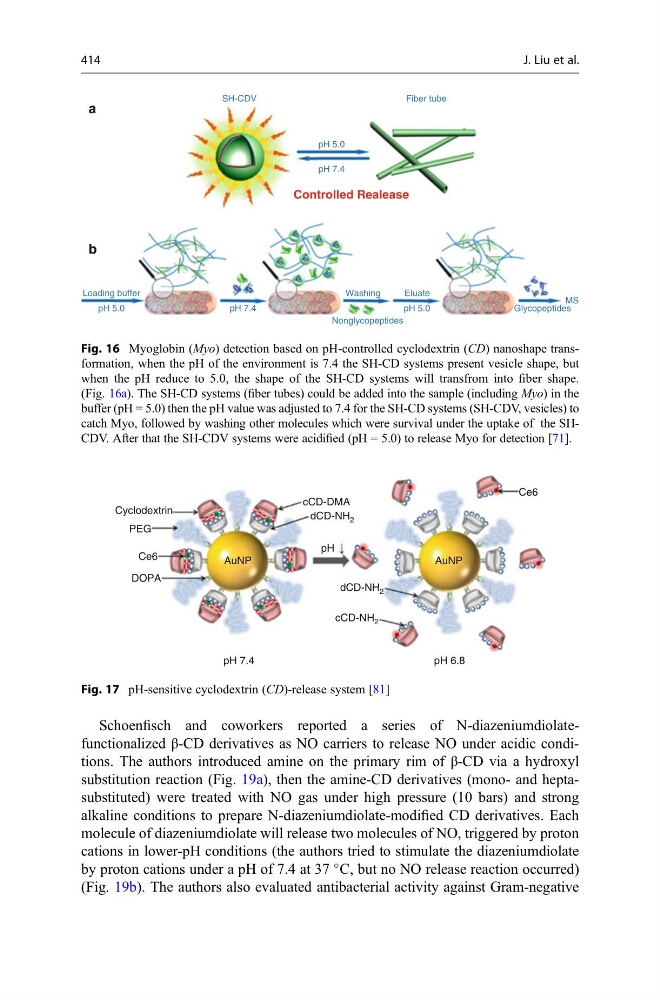
Fig. 16 Myoglobin (Myo) detection based on pH-controlled cyclodextrin (CD) nanoshape transformation, when the pH of the environment is 7.4 the SH-CD systems present vesicle shape, but
when the pH reduce to 5.0, the shape of the SH-CD systems will transfrom into fiber shape.
(Fig. 16a). The SH-CD systems (fiber tubes) could be added into the sample (including Myo) in the
buffer (pH = 5.0) then the pH value was adjusted to 7.4 for the SH-CD systems (SH-CDV, vesicles) to
catch Myo, followed by washing other molecules which were survival under the uptake of the SHCDV. After that the SH-CDV systems were acidified (pH = 5.0) to release Myo for detection [71].
Cyclodextrin
cCD-DMA
dCD-NH 2
Ce6
cCD-NH 2
pH
pH 7.4
AuNP
AuNP
pH 6.8
dCD-NH 2
PEG
Ce6
DOPA
Fig. 17 pH-sensitive cyclodextrin (CD)-release system [81]
414
J. Liu et al.
substitution reaction (Fig. 19a), then the amine-CD derivatives (mono- and heptasubstituted) were treated with NO gas under high pressure (10 bars) and strong
alkaline conditions to prepare N-diazeniumdiolate-modified CD derivatives. Each
molecule of diazeniumdiolate will release two molecules of NO, triggered by proton
cations in lower-pH conditions (the authors tried to stimulate the diazeniumdiolate
by proton cations under a pH of 7.4 at 37
C, but no NO release reaction occurred)
(Fig. 19b). The authors also evaluated antibacterial activity against Gram-negative
SH-CDV
Fiber tube
pH 5.0
pH 7.4
Loading buffer
pH 5.0
pH 5.0
pH 7.4
Washing
Nonglycopeptides
Controlled Realease
Glycopeptides
MS
Eluate
a
b
Fig. 16 Myoglobin (Myo) detection based on pH-controlled cyclodextrin (CD) nanoshape transformation, when the pH of the environment is 7.4 the SH-CD systems present vesicle shape, but
when the pH reduce to 5.0, the shape of the SH-CD systems will transfrom into fiber shape.
(Fig. 16a). The SH-CD systems (fiber tubes) could be added into the sample (including Myo) in the
buffer (pH = 5.0) then the pH value was adjusted to 7.4 for the SH-CD systems (SH-CDV, vesicles) to
catch Myo, followed by washing other molecules which were survival under the uptake of the SHCDV. After that the SH-CDV systems were acidified (pH = 5.0) to release Myo for detection [71].
Cyclodextrin
cCD-DMA
dCD-NH 2
Ce6
cCD-NH 2
pH
pH 7.4
AuNP
AuNP
pH 6.8
dCD-NH 2
PEG
Ce6
DOPA
Fig. 17 pH-sensitive cyclodextrin (CD)-release system [81]
414
J. Liu et al.