

Pseudomonas aeruginosa, a model pathogen associated with a number of serious
medical infections (for example, in patients with traumatic burns or cystic fibrosis)
[86, 87]. The results displayed significant antibacterial action and showed the
potential for codelivery of other drugs by CD cavity encapsulation [88].
On the basis of the host–guest interaction between Azo and CD, Chen and
coworkers designed and prepared a photoresponsive multivalent supramolecular
system immobilized on a gold platform. The gold platform supported the whole
system, which included a thiol–Azo part linking the Azo to the gold platform via
thiol–gold interaction and the β-CD conjugate 7-mannose, which can specifically
recognize and bind to the type 1 fimbriae protein (such as FimH) expressed on the
surface of many Gram-negative bacteria (like Escherichia coli) [89]. When the CD
with mannose attaches to the bacteria, they can be immobilized on the gold via
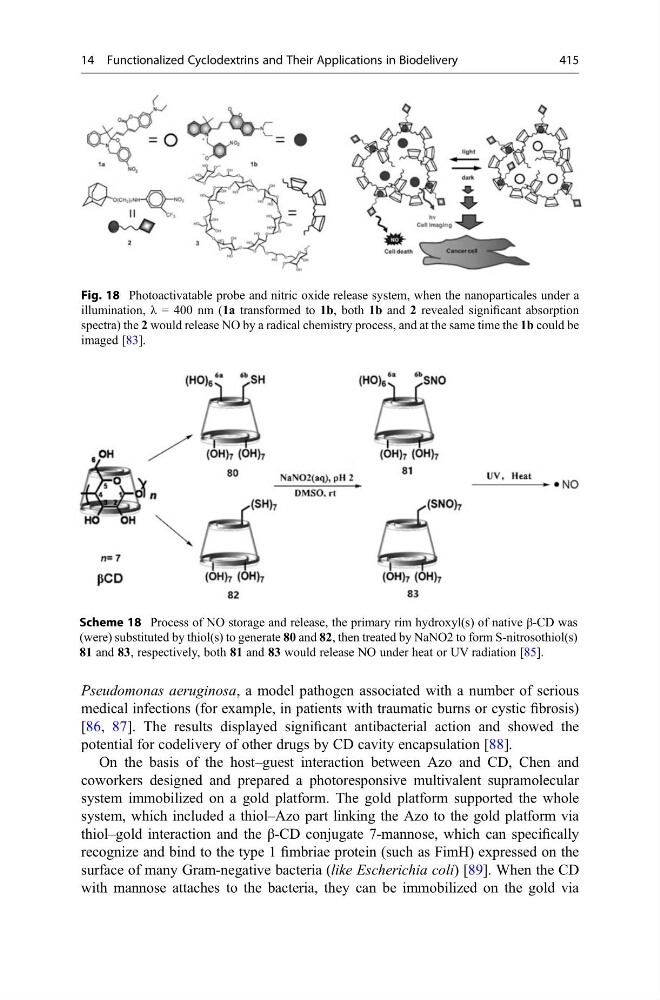
Fig. 18 Photoactivatable probe and nitric oxide release system, when the nanoparticales under a
illumination, λ = 400 nm (1a transformed to 1b, both 1b and 2 revealed significant absorption
spectra) the 2 would release NO by a radical chemistry process, and at the same time the 1b could be
imaged [83].
Scheme 18 Process of NO storage and release, the primary rim hydroxyl(s) of native β-CD was
(were) substituted by thiol(s) to generate 80 and 82, then treated by NaNO2 to form S-nitrosothiol(s)
81 and 83, respectively, both 81 and 83 would release NO under heat or UV radiation [85].
14 Functionalized Cyclodextrins and Their Applications in Biodelivery
415
medical infections (for example, in patients with traumatic burns or cystic fibrosis)
[86, 87]. The results displayed significant antibacterial action and showed the
potential for codelivery of other drugs by CD cavity encapsulation [88].
On the basis of the host–guest interaction between Azo and CD, Chen and
coworkers designed and prepared a photoresponsive multivalent supramolecular
system immobilized on a gold platform. The gold platform supported the whole
system, which included a thiol–Azo part linking the Azo to the gold platform via
thiol–gold interaction and the β-CD conjugate 7-mannose, which can specifically
recognize and bind to the type 1 fimbriae protein (such as FimH) expressed on the
surface of many Gram-negative bacteria (like Escherichia coli) [89]. When the CD
with mannose attaches to the bacteria, they can be immobilized on the gold via
Fig. 18 Photoactivatable probe and nitric oxide release system, when the nanoparticales under a
illumination, λ = 400 nm (1a transformed to 1b, both 1b and 2 revealed significant absorption
spectra) the 2 would release NO by a radical chemistry process, and at the same time the 1b could be
imaged [83].
Scheme 18 Process of NO storage and release, the primary rim hydroxyl(s) of native β-CD was
(were) substituted by thiol(s) to generate 80 and 82, then treated by NaNO2 to form S-nitrosothiol(s)
81 and 83, respectively, both 81 and 83 would release NO under heat or UV radiation [85].
14 Functionalized Cyclodextrins and Their Applications in Biodelivery
415